HARRY MC
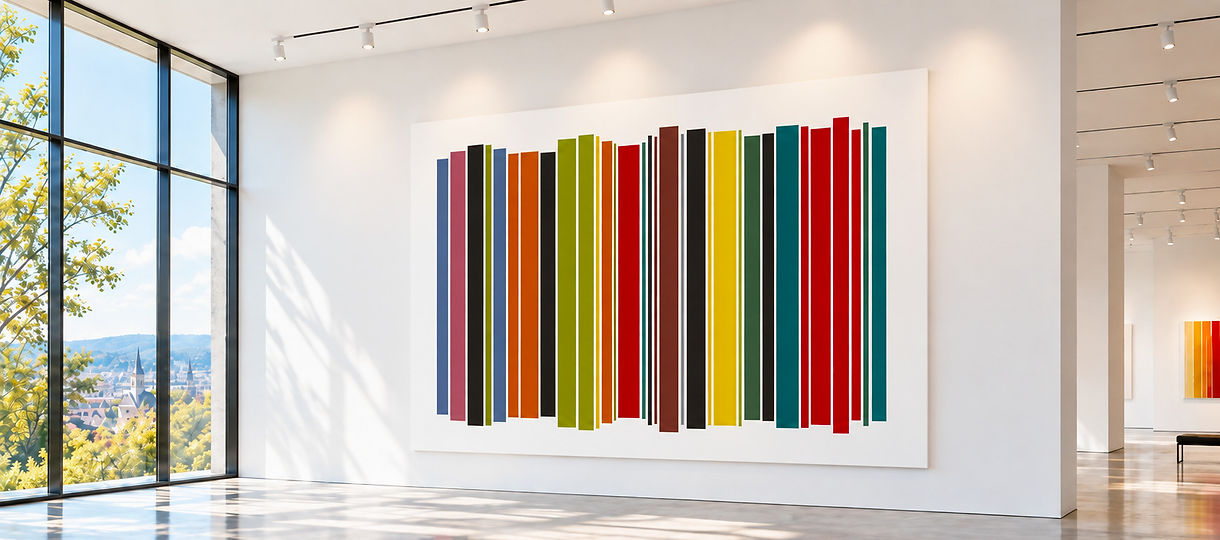
A British abstract artist:
Working with large-format and museum-scale vertical stripe paintings.
A British abstract artist working with large-format and museum-scale vertical stripe paintings. Harry MC uses vertical bands of colour as a language to explore time, place and visual rhythm. Light, colour, action: working between Bath and Provence, his fieldwork begins with walking, looking and photographing architecture, landscape and the structures of everyday life. Back in the studio, those observations are reduced to a disciplined form of linear abstraction, testing how far a sense of place can be held in paint, built slowly, one stripe at a time.


Measured Intervals is a book by stripe painting artist Harry MC, developed from fieldwork and photography in the Marseille area. It continues the architectural stripe investigation in a distilled register, less about accumulation, more about proportion, pause, and how a canvas holds light. The paintings are not pictures of the city but translations of what they demonstrate most clearly: vertical division as a way of organising vision, and colour as something discovered through adjacency rather than explained by story. The fieldwork gathers evidence rather than “views”.
Measured Intervals - Marseille
Measured Intervals is a body of work by Harry MC that continues the architectural stripe investigation in a more distilled register, less about accumulation, more about proportion, pause, and how a canvas holds light. The Marseille fieldwork sharpened that direction, with MUCEM acting as a modern Mediterranean instrument: a lattice screen that turns sea-light into shifting grids and makes separation feel structural, plane from plane, light from shadow, solid from void.
The Marseille paintings combine fieldwork photography with studio studies that test stripe width and height, interval, and colour adjacency. Narrow white separations function as measured pauses, sharpening edges and allowing each colour to establish its temperature cleanly. The colour field “floats” within a white ground, stopping short on all four sides, shifting the work from pattern toward objecthood, a calibrated architectural presence rather than a surface effect.

A book of Harry MC stripe paintings and their design studies

Measured Intervals series, pigment and oil on canvas, 90 x 120 inches

Measured Intervals series, pigment and oil on canvas, 90 x 110 inches
Bamboo: The Living Stripe
Bamboo is one of the most complete stripe environments found in nature. Its vertical canes repeat, lean, darken, weather and shift in the light, but never, it seems, in quite the same way twice. New fieldwork in southern France has opened a fresh strand in Harry MC’s continuing study of colour and the vertical line. Bamboo offers a rare kind of stripe: not printed, designed or imposed, but grown, a living vertical structure shaped by light, water, fibre and time. Photographs and field notes from this journey are feeding into new museum-scale painting in the Bath studio, exploring bamboo not as a botanical subject, but as rhythm, density, colour and observation. Read more on Bamboo: The Living Stripe.


A fieldwork photograph alongside a large format, pigment and oil on canvas, stripe work from the Harry MC ‘Bamboo: The Living Stripe’ series.

The Interrupted Stripe, a study for a 6ft x 6ft painting,
Stacked Interruptions extends The Interrupted Stripe series into a denser and more elusive field. Small horizontal passages of colour appear to float across the white ground, yet their repeated alignments slowly begin to gather into vertical columns. The eye moves between fragment and structure, between interruption and continuity, until the stripe reasserts itself not as a single band, but as something reconstructed through rhythm, spacing and memory. What first appears horizontal remains quietly governed by the vertical, giving the painting a shifting, optical presence that changes with distance and attention.
The Interrupted Stripe
Sometimes one painting becomes the fieldwork for another.
The Interrupted Stripe extends Harry MC’s continuing exploration of the vertical. Beginning with a painting from Bamboo: The Living Stripe, Harry retains its palette of greens, ochres, greys and near-black, but breaks the continuous bands into measured passages.
The unequal widths, changing heights and white spaces remain rooted in Harry’s established stripe language. But something different has happened: the interval that once separated one stripe from the next now enters the stripe itself. Continuity gives way to cadence, yet the vertical holds.
Read more — The Interrupted Stripe / World of Stripes


Books: see the Writing & Research page


Harry MC’s painting practice is accompanied by his books, where he writes about treating stripe painting as a sustained working method rather than a visual style. Developed through long-term fieldwork and research these books set out how vertical bands translate observation into abstraction, a practical language of proportion, interval, colour temperature, and light. His books are held in the permanent collection of many of the world’s top art research libraries including The Metropolitan Museum of Art, Tate, Getty Research Institute and Rijksmuseum Research Library.
Ostia Antica: Fieldwork & Studies
A return visit to Ostia Antica opened a new chapter in Harry’s work. The field-trip was driven by the search for a place where structure, time, and atmosphere could still be felt at full scale: long streets, brick walls, pillars, fragments of plaster and wall painting, and the calm of an ancient city still legible in its surfaces. The sheer physical scale of Ostia also asked for a larger response in paint.
The paintings remain rooted in Harry’s long stripe practice, but shift it into a darker register. Keeping the floating vertical structure of recent works, they set terracotta, olive, burnt sienna and red ochre against a black ground, with black intervals carrying the rhythm of the painting. The result stays recognisably part of the same continuing language, while drawing a new atmosphere from Ostia’s archaeology, scale and silence. See the full report - Ostia: Fieldwork & Studies.

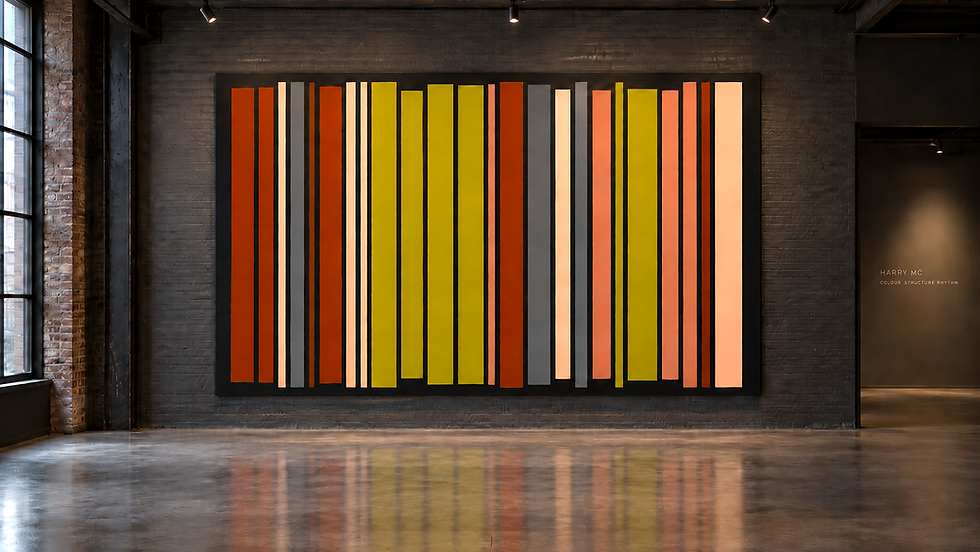
A Harry MC Ostia Antica multi-coloured stripe painting visualised hanging in a room setting


HARRY MC large-format paintings from the Ostia series ( 96 x 120 inches), pigment and oil paint on canvas, together with ( above) a fieldwork photograph of a vertical structures at the ruins.
Lignes d’Arles: Architectural Stripes in Provence Light
Lignes d’Arles distils Provence into light, colour and vertical rhythm. Pale olives, chalky yellows, ochres and sharp greens rise from an open white ground, carrying something of sunlit walls, shutters and the fractured geometry of Arles.
The result is not a picture of Provence, but its atmosphere reorganised into colour, southern light held in vertical form.
Read more — Lignes d’Arles / Architectural Stripes in Provence Light

Horizontal: Is the Prefix to Vertical
In Horizontal is the Prefix to Vertical, the painting begins at its edge. A compact sequence of horizontal bands is laid down first, establishing the colour relationships from which the larger vertical field will be constructed. What might normally remain a private studio exercise, a test or a preliminary note, is retained within the finished work and given equal visual authority.
The horizontal therefore becomes more than a counterpoint to Harry MC’s long-established vertical language. It is its beginning. Colour is first tested, ordered and held laterally, then released into the larger vertical structure beside it. One part of the painting becomes the source material for the other.
The result is a work that carries the memory of its own making. The narrow horizontal register acts almost like a visible prologue: compressed, provisional and intimate, while the vertical field expands those same chromatic decisions into scale. The relationship is neither decorative nor oppositional. The horizontal does not compete with the vertical; it precedes it, seeds it and gives it direction.


When the horizontal register appears on both sides, the painting opens into a more complex rhythm. The vertical field is held between two compressed sequences of colour, as if bracketed by its own chromatic memory. What begins at one edge returns at the other, not repeated, but transformed.
The short horizontal marks remain intimate and concentrated, while the central stripes expand into architectural scale. The painting moves from compression to release, from notation to presence, allowing horizontal and vertical to exist not as opposites, but as two expressions of the same underlying structure. Compressed at the margins, released through the centre.