HARRY MC

Measured Intervals - Marseille
A Book of Stripe Paintings and their Design Studies
Measured Intervals is a book by stripe painting artist Harry MC, developed from fieldwork and photography in the Marseille area. It continues the architectural stripe investigation in a distilled register, less about accumulation, more about proportion, pause, and how a canvas holds light. The paintings are not pictures of the city but translations of what they demonstrate most clearly: vertical division as a way of organising vision, and colour as something discovered through adjacency rather than explained by story. The fieldwork gathers evidence rather than “views”.

Marseille offers a contemporary architectural education in concrete, steel, glass and maritime reflection, with scale shifting quickly from intimate streets to vast cultural buildings and working harbour infrastructure. Certain sites make the interval logic unusually legible. MUCEM acts as a key reference point: its concrete lattice remains fixed, yet appears endlessly variable as sun angle and sea-light change. Around the Vieux-Port, masts, barriers, railings and pilings accumulate into structures that begin to read as measured rhythm once you stop seeing them as clutter. Fort Saint-Jean tightens the experience into courtyards and cut shadow; the lanes of Le Panier return the city to human scale, repetition, repair, typography, and surfaces continually rewritten.
This Marseille volume of Measured Intervals brings together the elements of the work - fieldwork photographs, studio studies and completed stripe paintings. The stripe width and height, the spacing of intervals, and colour adjacency are inside a deliberately limited language. Narrow white separations function as measured pauses, not decoration, sharpening edges and allowing each colour to establish its temperature cleanly. The colour field “floats” within a white ground, stopping short on all four sides, shifting the work from pattern toward objecthood: colour suspended within light, the sequence reading as a calibrated architectural presence rather than a surface effect. Within that field, widths are deliberately unequal and heights vary, preventing the rhythm from becoming a fence; the widest bands carry weight, the narrowest accelerate the cadence, and the whole holds its clarity while remaining responsive and alive.
Marseille’s character also widens the stripe palette. Alongside maritime blues and concrete greys, other notes enter as the fieldwork broadens, warmer stone, sharper graphic contrasts, occasional flashes of colour, while the discipline remains constant: measured relationships held steady through interval, proportion, and sequence. This is a book made primarily as a gallery object and studio reference, a way of showing the range of large-scale resolutions within the Marseille register, and a way of keeping the work anchored in observation.
Inside the book, Marseille becomes a place of measured looking as much as movement: façades, shutters, harbour edges, concrete shadows, painted surfaces, sea light and architectural fragments all finding their way into the language of stripes. The book traces how observation turns gradually into abstraction, not by leaving the world behind, but by studying it more closely. Colour relationships, repeated divisions and small shifts of proportion are treated as part of the city’s visual rhythm. What emerges is not simply a record of Marseille, but a quieter account of how place, structure and light can be absorbed into painting.
Fieldwork locations referenced in the Marseille archive include the Cité Radieuse by Le Corbusier, Maison Empereur, La Friche la Belle de Mai, and Fondation Carmignac.
Hardback · 216mm x 279mm landscape · 96 pages · Published by Florence & Gertrude Editions · ISBN 978-1-9195016-2-8

The Norman Foster designed Ombrière beside Marseille old port
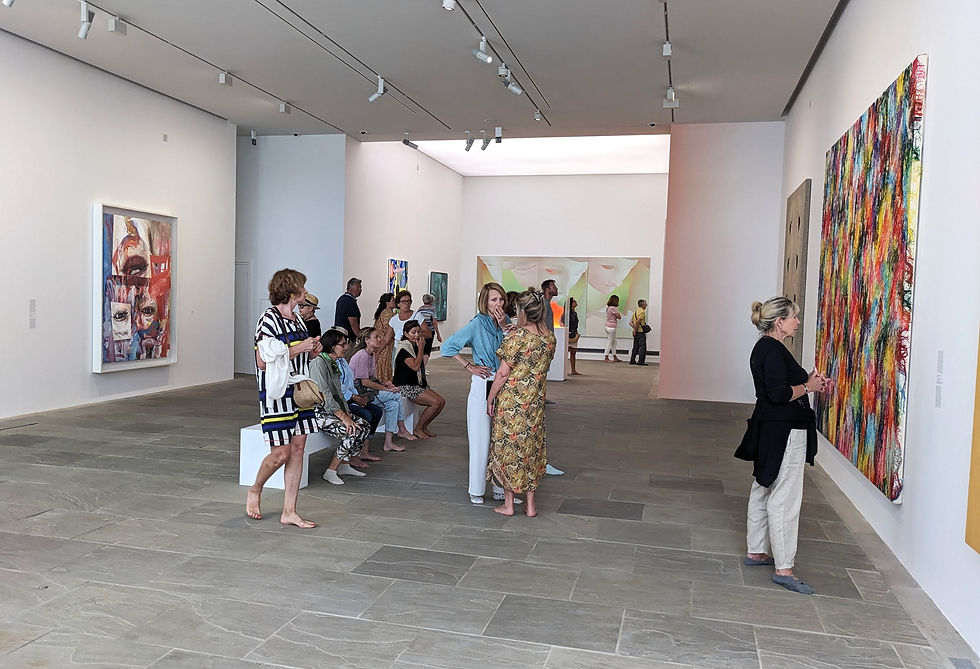
Barefoot visitors at Fondation Carmignac viewing the artworks