HARRY MC

HARRY MC - WORLD OF STRIPES PROJECT
AN ONGOING RESEARCH PROJECT INTO STRIPE PAINTING
Exploring abstraction, colour and geometry through the world’s stripe-painting artists.
World of Stripes is Harry MC’s ongoing research project into stripe painting, colour, rhythm and the vertical line. It places his own large-scale stripe paintings in conversation with the wider tradition of artists who have used stripes as a serious structure for abstraction, from Bridget Riley, Sean Scully and Daniel Buren to Gene Davis and the continuing language of contemporary colour painting.
Harry is a British abstract artist working between a Georgian studio in Bath and long-running fieldwork in Provence. His paintings are built from vertical bands of colour, but they are not decorative patterns. They grow from observation: light on stone, ochres in the landscape, shutters, facades, shadows, weather, roads, architecture and the shifting colour of place.
One strand of the research sits on the Provence Fieldwork page, where studio paintings are shown alongside notes and photographs from Saint-Rémy, Arles, and the wider region.
In this context, a stripe artist is an artist whose primary practice is built around repeated bands or lines as the main structure of the work. Stripe artists use interval, edge, proportion and colour to test how a painting can hold rhythm, light and experience without relying on representation.
For Harry, the stripe is both discipline and discovery. Each painting begins with structure, then develops through colour testing, surface adjustment and long looking. The vertical bands hold the work steady while light, memory and place enter the painting one decision at a time.
World of Stripes brings these ideas together through exhibition visits, artist studies, fieldwork notes and reflections on the history and future of stripe painting. It is where the studio language of vertical bands meets the wider stripe tradition and where Harry’s own work can be seen as a contemporary British contribution to a form that remains open, rigorous and alive.
Daniel Buren at Giverny: Stripes, Gardens and the Space Between
A World of Stripes field note on Daniel Buren’s Plantations, travaux in situ, 2026, at the Musée des impressionnismes Giverny, 17 July–1 November 2026.
Daniel Buren’s forthcoming exhibition at the Musée des impressionnismes Giverny brings one of the most recognisable stripe artists in modern art into direct conversation with gardens, colour, light and movement. Buren was born in Boulogne-Billancourt, France, in 1938 and has worked with stripes for more than sixty years. Since 1965, his visual language has been built around alternating white and coloured vertical bands measuring 8.7 cm wide. It is one of the clearest signatures in contemporary art: simple, regular and immediately recognisable
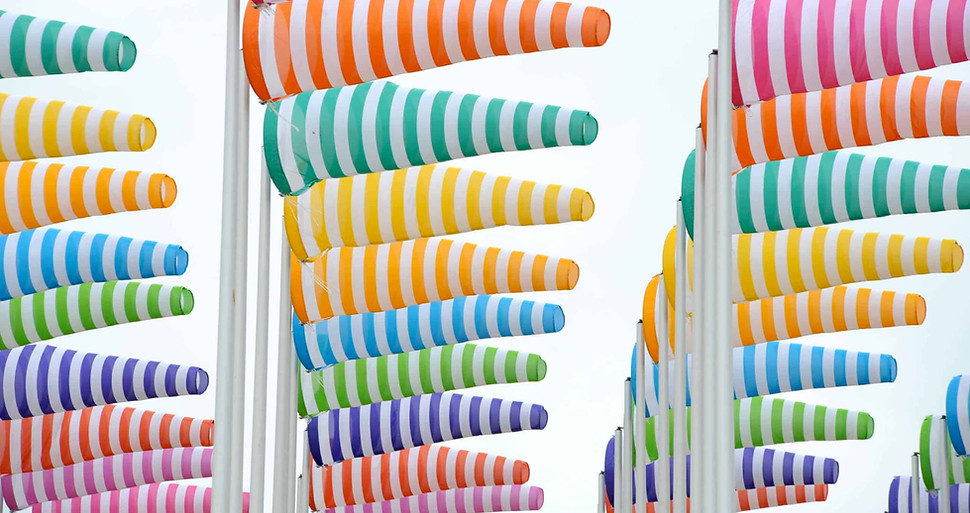
Daniel Buren, Photo-souvenir: Le Vent souffle où il veut, 2009. © DB / ADAGP, Paris, 2026. Image: Musée des impressionnismes Giverny.
The Giverny museum has invited Buren to create a new work that extends from the gardens into the museum interior. This is not simply a display of stripe paintings in a gallery. It is a site-specific installation in which colour, architecture, landscape and movement become part of the work. The setting is important. Giverny is inseparable from Claude Monet, from gardens, water, reflection and the changing effects of light. Buren enters that landscape from a very different direction. Monet and the Impressionists painted the shifting surface of the world; Buren places colour directly into the space the viewer walks through. His stripes are encountered by moving past them, around them and through them.
For Harry MC, this makes the exhibition especially relevant. The World of Stripes project has always been interested in what happens when stripes move beyond pattern and become a way of thinking about place. Harry’s own paintings begin with fieldwork: the ochres of Provence, the light on Bath stone, the geometry of shutters and facades, and the changing colour of roads, walls, shadows and weather. These observations are not copied literally. They are gathered, remembered and rebuilt in the studio as vertical bands of colour.
Buren works almost the other way round. Rather than bringing a place back into painting, he takes the stripe into a place and lets the setting complete the work. His method is architectural and situational. Harry’s is painterly, material and studio-based. One depends on the regularity of a repeated visual tool; the other depends on colour testing, surface, edge, scale and the slow adjustment of paint. The difference is useful because it shows how many routes the stripe can take.
There is also a shared interest in scale. Harry’s museum-scale stripe paintings have an architectural presence. They do not behave like small pictures. They alter the wall, affect the room and change the pace of looking. In that sense, even though Harry MC remains a painter and Buren is known for in situ installations, both artists are concerned with how vertical colour operates when it becomes larger than the body.
Seen alongside Bridget Riley and Sean Scully, Buren clarifies a third route through the stripe. Riley shows how stripes can make the eye move. Scully shows how stripes can carry touch, weight and feeling. Buren shows how stripes can change a place. Harry MC’s own contribution sits within this contemporary stripe tradition while remaining rooted in fieldwork, large-scale painting, and the observed colour of places like Bath and Provence.
Buren’s Giverny exhibition is a reminder that the stripe is not a closed modernist device, but a living structure: capable of holding light, place, movement, memory and scale.
Bridget Riley in Margate: Field Notes on Light, Rhythm and Stripes
Observations from the opening of “Learning to See” at Turner Contemporary
The opening of Bridget Riley’s Learning to See at Turner Contemporary offered a rare chance to watch viewers negotiate colour, rhythm and optical tension in real time. For Harry MC, the trip formed part of his ongoing World of Stripes research — following how stripes behave across different geographies and how people react when geometry begins to move. What follows are his field notes from Margate.

The Turner Contemporary is an interesting building but it's grey facade can look bland on a dull winter's day. Harry MC has given it an uplifting stripe make-over in celebration of Bridget Riley's exhibition "Learning to see" which runs in Margate until 4th May 2026.
When Bridget Riley returns to the Kent coast, it always feels like a circuit closing. The sea-light that shaped her earliest experiments is the same light that washes across Turner Contemporary today, shifting from silver to chalk-blue as the tide rolls in. It was into this atmosphere that Harry MC travelled for the opening of Learning to See — a survey of Riley’s six decades of optical research and one of the most precise demonstrations of visual rhythm he has witnessed in recent years.
For Harry, the visit was not simply a gallery trip; it was part of his ongoing World of Stripes work, a project that follows how colour behaves in different places, how geometry changes under pressure, and how people physically respond when a painting asks them to pay attention.
Margate light and the geometry of the sea
The first impression is always the horizon. The North Kent coast has a way of flattening the world into bands: sea, haze, sky, three long stripes, each vibrating with different frequencies. Riley once described this coastline as “a continuous exercise in adjustment,” and that phrase threads through Harry’s notebooks from the day. The light never settles; it keeps rearranging itself. Even standing still, the colour moves. Outside the gallery, Antony Gormley’s Another Time stands on Fulsam Rock, only visible at low tide. A solitary figure staring out to sea — a vertical line against all that horizontal drift. Harry paused here before entering, noting how even the sculpture feels like a stripe under certain conditions: a dark pillar against luminous water.
Inside the exhibition — negotiating the stripes
Riley’s rooms unfold slowly. Vertical bands, diagonal cuts, waveforms, rare curves — each painting a choreographed sequence designed to destabilise the eye. Harry often speaks about stripes as a “steadying device,” but here, the effect is reversed: the paintings demand constant recalibration. Viewers lean in, tilt their heads, adjust their footing, step back. Children move more freely; adults try to remain composed but can’t resist the pull. Harry photographed these responses throughout the galleries — not as documentation but as part of his research into how people inhabit stripes. A young girl in a striped jumper approaching a diagonal Riley piece became, in his words, “a perfect demonstration of how looking becomes physical.” Two men stood in front of a wave painting, unconsciously mirroring its rhythm. A group gathered around a major horizontal stripe work, each person reading the surface at a slightly different pace.


One of the quiet observations of the exhibition was how naturally Riley’s work bridges generations. A young girl leaned into a diagonal sequence with the same curiosity shown by older visitors studying the long wave paintings — a reminder, Harry often says, that stripes speak to something universal before they speak to style.
Riley, Turner, Austen — and Bath’s long diagonal
This year marks the 250th anniversary of J.M.W. Turner’s birth. It also marks 250 years since Jane Austen, who once lived only steps from Harry’s Bath studio, entered the world. The coincidence is not trivial. Both Turner and Austen were obsessed with perception, light in one case, social pattern in the other and Riley is often discussed as an heir to that same tradition of British clarity. In Bath, Harry’s studio also sits close to Gainsborough’s former address in the Circus, linking him to another local lineage of artists who understood structure as a form of inquiry. “It all feeds in,” he says. “Turner recorded the vibration of the sea. Riley records the vibration of looking. Austen records the vibration of thought. Stripes are just my way of measuring it.” Margate follows closely on Harry’s fieldwork in Provence, where he photographed the newly reopened rooms of Van Gogh’s hospital at Saint-Rémy. Those photographs,unseen until now, form the basis of his upcoming Van Gogh DNA piece for World of Stripes. Between Margate, London, Provence and Bath, Harry is mapping a broad field: how artists repeatedly return to light, rhythm and structure to explain the world. As Harry writes in his marginal note from the opening day: Riley proves that limits don’t close down expression, they generate it. A disciplined grammar is what makes freedom possible. That sentence could stand as the manifesto for the entire World of Stripes project. Colours shift. light changes. people move. But the structure, the stripe, holds everything steady long enough for perception to do its work. And in Margate, on a cold November afternoon, that mechanism was as clear as the horizon line that has inspired British artists for generations.
Bridget Riley in the stripe story
Stripes play a starring role in Bridget Riley’s work because they give her a way to test the act of seeing itself. In the 1960s she used black-and-white stripes to make the eye feel unstable, then turned to colour and adopted the vertical stripe as her most “fundamentally stable” format. The geometry stays quiet; the colour does all the work. Repetition forces you to look slowly – small shifts of hue inside or between stripes create a sense of vibration, drift or pulsing movement across the surface.
Riley has always insisted that her stripe paintings are not just visual tricks. She spent years studying colour interactions (via Seurat) and thinking about how after-images, light levels and viewing position change what we see. The stripe became her armature for a kind of visual music – a way to move from pure retinal excitement into genuine feeling. In that sense, Riley’s stripes opened the door for later painters, Harry included, to treat the stripe as a serious tool rather than a gimmick.

-
For the fieldwork-to-studio method behind stripe paintings, see The Vertical Line: Observation and Abstraction in Contemporary Painting.
-
For the wider argument — perception, pattern, and realism without depiction — see Stripe Painting: Observation and Realism in Abstract Art.
Selected essays from Stripe Painting


Sean Scully at the Estorick: Surface, Structure, and the Rhythm of Colour
Scully’s paintings are formed through repetition and adjustment, each block responding to the next in tone, temperature and weight. It’s an approach that mirrors the way Harry MC negotiates his own vertical bands of colour — structure held lightly, rhythm found slowly.

For Harry MC, stripes are not simply a recurring device but a discipline, a way of structuring colour, emotion and place into something that feels both measured and instinctive. Seeing Sean Scully’s work at the Estorick Collection reinforces that sense of kinship. Scully’s canvases, with their stacked blocks, worn edges and layered histories, approach abstraction as a slow accumulation of decisions. Harry’s practice follows a similar rhythm: vertical bands built through repetition, revision, abrasion and renewal until the painting settles into its own internal logic.
Scully’s surfaces do most of the talking. They carry the marks of previous attempts, ghost colours pushed back into the weave, edges softened as if the work has been handled, lived with, reconsidered. Harry approaches his own canvases in much the same way. Stripes are added, scraped, re-asserted, then weighted against their neighbours. Nothing is fixed until the whole has found its balance. Both artists treat abstraction not as a clean geometry but as a human process, a record of time spent negotiating with colour.
There is also a shared belief in the physicality of paint. In Scully’s large works, broad bars of colour press against each other like architectural elements, heavy yet breathing. Harry’s stripes, though different in orientation, carry that same sense of heft, colour laid down with enough confidence to feel structural, yet open enough to reveal the underlayers. The surfaces in both practices are built rather than applied, they reward close looking, where the brushwork becomes a kind of topography.
What stands out most is how both painters use repetition not as a formula but as an opening. Scully’s blocks, reordered and re-coloured across decades, become a long conversation with himself. Harry’s vertical stripes perform a parallel function: each new canvas asks what the rhythm needs today, more compression, more air, more tension between saturated and muted tones. In both studios, repetition is a way of staying alert, not settling.
The Estorick exhibition offers a useful clarity: you see how a lifetime of returning to a simple motif can yield endless variation and emotional depth. It mirrors what Harry pursues in the Bath studio. The stones outside may change with the weather, but the stripe remains his constant, a framework sturdy enough to hold the unpredictability of colour and the quiet architecture of light.
This is where the World of Stripes project connects so directly to Scully, the idea that abstraction can be intimate, tactile and grounded in lived experience. A stripe is never just a stripe, it’s a boundary, a moment, a fragment of decision. And in the hands of both painters it becomes a way of making sense of the world one measured band at a time.
What also struck Harry at the Estorick was the setting itself. The Georgian townhouse, with its generous proportions and steady north-facing light, felt uncannily close to his own studio in Bath. Rooms that breathe, rooms that allow colour to unfold slowly, these architectural qualities matter and they shape how a painting reads. Seeing Scully’s work in that environment underscored the quiet conversation between their practices: two studios, two cities, both shaped by light that insists on calm discipline. Scully’s connection to Provence adds a further point of resonance. He has long kept a home and studio near Aix-en-Provence, drawn to the clarity of the light and the landscape’s measured horizontals. Harry understands that pull all too well. Provence has been a recurring part of his own working life for almost three decades, a region where colour behaves differently, where sunlight sharpens the edges of every shape. Both painters, in their own ways, work between two poles, a northern studio defined by geometry and weather, and a southern one shaped by heat, colour and open air. The stripes respond accordingly.

Sean Scully’s paintings reveal the slow, cumulative nature of abstraction, colour added, revised, softened and rebuilt until the composition holds its own weight. In his Bath studio, Harry MC works with a similar attentiveness. His vertical stripes are layered and negotiated, each band responding to the next in tone, density and rhythm. Like Scully, Harry lets the history of the painting remain visible, edges stay open, underlayers breathe through, and the geometry adjusts to the shifting studio light. It’s not imitation but a shared sensibility, abstraction as steady work, carried out one deliberate mark at a time.

The Estorick Collection brings together some of the most important works by Italian artists during the first half of the twentieth century, and is Britain’s only museum devoted to modern Italian art. It occupies a Georgian townhouse in Canonbury Square in London, a setting that lends the galleries an unexpected intimacy. The tall windows, pale walls and soft, directional light give the paintings room to breathe. For Harry MC, the atmosphere felt instantly familiar. It echoed the Bath studio, with its own Georgian proportions and shifting stone tones, and reinforced how architecture quietly shapes abstraction. Alongside the Sean Scully exhibition, the museum’s permanent collection presents its “hero” works: Modigliani’s elegant portraits, Campigli’s stylised figures, and key examples of early Italian modernism. These works form a lineage of clarity, restraint and surface handling that sits naturally beside Scully’s own language. The building ties it all together — a calm structure holding decades of experimentation, from historical modernism to contemporary abstraction.


Sean Scully and the rough-hewn stripe
By the late 20th century, stripes were no longer a radical novelty; they had become a kind of classical abstract language. Sean Scully took that language and roughened it up. His big canvases are built from bands and blocks that resemble enlarged, weathered stripes – layered, overpainted, brushy at the edges. Where the 1960s stripe painters often aimed for hard-edge precision, Scully leans into weight, melancholy and history.
He has compared his stripes to fragments of awnings, textiles and walls seen on his travels, and even to Cézanne’s brushstrokes. In his work the band becomes a carrier of memory rather than a purely formal device. Critics have described his paintings as “fragments of striped awnings and fabrics, transposed onto canvas with a sense of weathering and time.” For Harry, Scully is inspirational, proof that stripes can be both strict and emotional, that the format can hold roughness, mortality and experience without losing its basic structure.
BAMBOO : THE LIVING STRIPE
Bamboo offers one of the most complete stripe environments found in nature. It is vertical, repeated, rhythmic and architectural, yet never mechanical. Each cane rises as a line, but each line carries its own slight variation of colour, thickness, angle, age and light which makes bamboo a compelling subject. It is not a decorative pattern placed upon a surface. It is not a stripe printed onto fabric, painted onto a wall, or designed as an optical device. It is a stripe that has simply grown into being.
Seen in southern France, between Provence and the Cévennes, bamboo carries a particular visual charge. The strong light, dry earth, shaded valleys and old watercourses give the canes a heightened presence. Green becomes gold. Gold cools towards grey. Older stems bleach and darken. Black bamboo introduces a more graphic, almost drawn quality, as though the plant has become a set of vertical marks standing in space. From a distance, a dense stand of bamboo can seem almost uniform. Close up, it is full of difference. The canes do not repeat like manufactured stripes. They gather, separate, lean, thicken, weather and interrupt one another. The spaces between them are never quite equal. The rhythm is ordered, but alive.
That balance between order and variation sits naturally within Harry MC’s wider stripe practice. His paintings often begin with the vertical line as a way of holding colour, light and place. A stripe may appear simple at first, but its effect depends on attention: width, interval, edge, temperature, pressure and scale. Bamboo presents these questions in living form. It is a natural structure already thinking in verticals.

This gives bamboo a different place within the stripe tradition. Much of twentieth-century stripe painting drew energy from optical perception, industrial fabric, architecture, geometry, musical rhythm or the discipline of repeated colour. Bamboo suggests another route: the stripe as growth. A vertical form shaped not by design, but by water, fibre, light, weather and time.
Colour is equally important. Southern France already carries a deep association with natural colour: ochres drawn from the earth, mineral tones in old walls, roof tiles, shutters, dry grasses, cypress, olive and stone. Bamboo adds another register to that palette. Its colours are not fixed. They alter according to species, age, surface, weather and light. Acid green, straw yellow, olive, smoky grey, dark brown and near black can all appear within the same visual field.
For an artist whose work has long been connected to colour, pigment and place, that variability is significant. Bamboo does not simply provide a set of vertical lines. It provides colour in relation to structure. The surface, the rhythm and the palette are all part of the same growing system.
The new museum-scale paintings developing from this research will draw on those ideas rather than describe bamboo literally. Photographs from the fieldwork become records of density, spacing, colour, shadow and scale. The painting may retain the memory of the grove without resembling it directly and the canes may become bands of colour. Bamboo extends the stripe beyond the studio and returns it to the observed world. It shows the vertical line not as an imposed pattern, but as a natural structure. A stripe before painting, a stripe made by growth, a living line shaped by light, water, fibre and time.
THE INTERRUPTED STRIPE
Sometimes one painting becomes the fieldwork for another.
The Interrupted Stripe begins not with a new journey or a new subject, but with one of Harry MC’s own paintings. Its starting point is a work from the series Bamboo: The Living Stripe. Those paintings developed from fieldwork in southern France, where bamboo offered Harry a naturally occurring vertical structure: repeated but never mechanical, with differences of width, height, colour, density and interval determined by growth rather than design. In the studio, those observations became vertical bands of colour. Green, olive, yellow, grey and near-black carried something of the bamboo without attempting to describe it literally. With The Interrupted Stripe, that process takes another turn. Harry returns not to the bamboo itself, but to the painting that resulted from it. Its palette becomes the source material for another work.
The Interrupted Stripe — design study for a 6ft x 6ft painting, oil on canvas.

The interval enters the stripe. Harry’s earlier stripe paintings have often depended as much upon the space between the bands as upon the bands themselves. In works such as Measured Intervals, stripes vary in width and height while narrow areas of unpainted ground establish pause, separation and rhythm. In The Interrupted Stripe, that interval performs a new role. It no longer only separates one stripe from another. It enters the stripe itself. The vertical bands are interrupted along their length, becoming sequences of coloured vertical passages separated by narrow horizontal intervals. Their widths differ; their upper and lower limits shift; individual colours change as the eye travels down the painting. Yet the underlying structure remains unmistakably vertical.
The horizontal divisions are not competing painted bands. They are absences, intervals cut across the vertical field. The painted information continues to rise and fall rather than travel sideways. Nothing has been abandoned; the stripe has simply been interrupted.
Continuity through colour where the palette strengthens that continuity. Rather than inventing a new colour scheme for the new structure, Harry has taken the colours directly from an existing Bamboo painting and redistributed them across the field. The chromatic relationships therefore survive even as their structure changes. The earlier painting is still present, but no longer in its original form. What was continuous becomes cadenced. What previously existed between the stripes now passes through them. A vocabulary already established through unequal widths, changing heights and active white space has been pushed one stage further.
The result is not a departure from stripe painting, but a reconfiguration of Harry’s existing vertical language. Harry’s practice has long begun with looking: architecture, landscape, natural structure, light, colour and the repeated forms encountered during fieldwork. But observation need not always begin outside the studio. A finished painting can itself become something to examine, its palette, proportions, intervals and internal relationships providing evidence for the next work.
Sometimes one painting becomes the fieldwork for another. That creates an interesting circular movement within the practice: observation becomes stripe; stripe becomes observation again. The original bamboo was looked at and translated into painting. Now the resulting painting is looked at in turn, becoming the starting point for another structural enquiry. What remains of the vertical? From a distance, The Interrupted Stripe presents a more dispersed field than Harry’s continuous stripe paintings. Closer inspection reveals that its basic unit has not changed. Each coloured element remains a vertical mark. The stripe has been shortened, interrupted and redistributed but not surrendered. The work therefore asks a deceptively simple question: What remains of the vertical when its continuity is withdrawn? The answer is still the vertical.

A close study of colour, texture and rhythm from an original Harry MC stripe painting.
Why Stripes Matter: A Stripe Artist’s Reflection on Colour, Light and Studio Geometry
Stripes have been part of Harry MC’s work long before he settled into the Bath studio. For Harry, stripes are not pattern but primary structure: large-format vertical stripe paintings built from field observation in Provence and resolved in the Bath studio as measured sequences of colour, interval and edge. They emerged early as a quiet discipline, a way of testing colour without leaning on form or gesture. A stripe reveals what the paint is actually doing. Over time, that directness stayed with him, evolving into a language of its own.
What Bath provided was not the origin of the stripes, but a kind of sharpening. The Georgian studio didn’t invent the impulse; it simply clarified why it had always been there. In this space, light arrives in bands: slender verticals sliding across the floor, tall shadows cast by the sash windows, soft rib-like reflections in the stone. Suddenly, the work and the room shared the same vocabulary. The stripes felt less like a motif and more like a way of acknowledging how light naturally organises space.
For Harry, a stripe has always been a small commitment to clarity — something steady, structured and honest. In Bath that clarity becomes almost architectural. The geometry of the studio doesn’t dictate the paintings, but it does shape the atmosphere around them, nudging the work forward. The space seems to echo what the stripes have long suggested: order, steadiness and a kind of disciplined openness.
He often describes stripes as a slow metronome. Each band marks a moment in the studio — a decision, a hesitation, a shift in confidence. Nothing hides inside a stripe: if the colour is wrong, it’s visible; if the brush falters, the surface records it like handwriting. That honesty is part of the appeal. After decades of painting, stripes still give Harry the same feeling as opening a new notebook: the sense that there is structure in the world, and that it’s possible to create more of it.
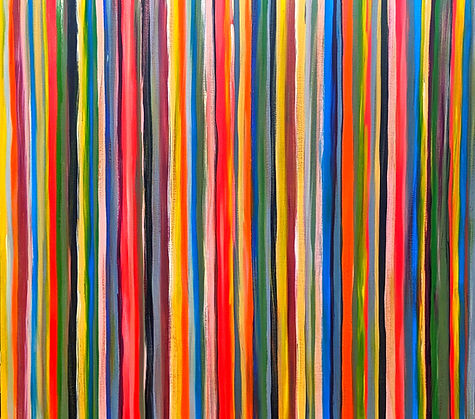
Despite their simplicity, stripes can hold enormous complexity. Up close, a viewer sees micro-textures, subtle breaths of pigment, tiny variations where the brush lifted. From a distance, the painting becomes architecture — a façade built from colour fields. This architectural sensation is one reason the Bath studio plays such a natural role in the work. Its tall proportions and gentle verticality echo through the paintings without ever becoming literal. Stripes translate that atmosphere into colour and rhythm.
People sometimes ask whether the stripes hold coded meanings or emotional messages. Harry’s response is always the same: the meaning lies in the colour. Each stripe is a field of colour given its own territory. Some hues vibrate against their neighbours; others settle calmly. This negotiation reflects the studio itself — the shifting weather, the changing light, the constant sense that the painting is alive and adjusting until it finally settles.
Another reason stripes matter in Harry’s practice is the balance they offer between discipline and spontaneity. The structure is stable — usually vertical bands — but within that order there is room for intuition. Colour, temperature, edge softness, layering: all can shift dramatically from day to day. Some works feel contemplative and pared back; others surge with energy. The stripes contain these moods without letting the composition collapse. They act as scaffolding, allowing the work to reach further.
Stripes also mark time. Harry often looks at older paintings and recalls the season, the studio atmosphere, or the weather during the week they were made. Winter stripes tend to concentrate and cool; summer stripes loosen and breathe. These changes aren’t deliberate, they are responses to the room itself. A Bath studio with this kind of history carries its own quiet momentum. Painting there is part of a longer continuum, the light shaped by centuries of use. Stripes register that continuity without overstating it.
Perhaps the simplest reason stripes matter is that they remain endlessly revealing. The more one looks, the more they disclose. They strip painting back to its essentials - colour, rhythm, balance, without theatricality. In a world saturated with imagery and noise, stripes offer a pause, a sense of visual breathing space. They prove that simplicity can still hold depth, and that reduction can lead to clarity rather than absence.
That is why Harry returns to them. Not out of habit, but because stripes continue to open new possibilities. Each one is a small discovery, a fresh line of enquiry. And in the Bath studio, with its shifting light and quiet geometry, stripes feel like the clearest way to record what the room is offering. They matter because they capture a conversation between colour and place, and Harry’s role is simply to follow where that conversation leads.
Colour, texture and time held inside every single stripe of a Harry MC painting
Related essay: Why Stripes? Harry MC, Alan Turing and the Natural Logic of Pattern continues this enquiry through Alan Turing’s 1952 theory of natural pattern formation, asking why stripes recur across nature, architecture and painting, and why this apparently simple form remains deep enough to sustain nearly five decades of Harry MC’s work.
Stripe Painting En Plein Air — Notes
When the Canvas Meets the Open Air
There is a long tradition in painting of going outside, not to escape the studio, but to test it. Artists have long taken their work into the landscape to see what happens when a disciplined method meets wind, shifting light and the physical presence of a particular place. For most of art history this was the territory of landscape painting. But the stripe has its own, quieter outdoor story: moments when the disciplined interval leaves the wall and encounters the open world.
En plein air — painting in the open air — emerged in the nineteenth century when artists began taking their work directly into the landscape. What happens when that approach is applied to abstraction, and specifically to stripe painting?
Stripe painting has always claimed a relationship to observation, to colour encountered in real conditions of light and atmosphere. But there is a difference between carrying a place back to the studio and being inside that place while decisions are being made. For artist Harry MC the question arises naturally through fieldwork. Walking through places where light, surface and architecture interact, whether in Provence or elsewhere, raises a simple possibility: what would happen if a stripe painting were begun directly within that environment? The stripe in Harry MC’s work is not a motif but a method, a way of translating observed light, architecture and the experience of place into colour.

Stripe painting in its natural habitat. AI-generated visualisation of an en plein air stripe-painting concept.
At moments in the history of stripe painting, artists have allowed the stripe to move outside the gallery. Gene Davis provided one of the clearest precedents. Known for his instinctive vertical stripe paintings produced in Washington studios, Davis occasionally expanded the stripe into the public environment. His Franklin’s Footpath stretched a long ribbon of colour across the street outside the Philadelphia Museum of Art, while later projects turned entire urban surfaces into fields of stripes. Daniel Buren developed this relationship between stripe and place into a complete philosophy. His in situ works insist that stripes respond to their architectural context, transforming the spaces in which they appear. When stripes leave the wall and enter the world, they become environmental, something you move through rather than simply look at.
For a painter whose canvases often reach architectural scale, working outdoors becomes less about transporting finished paintings than about making direct studies that feed the larger studio work. The outdoor painting becomes a form of observation, a way of recording colour relationships, light conditions and spatial rhythms in real time. The studio remains where the work ultimately finds its structure. But the field, whether a Provençal hillside, an architectural landscape or another environment of strong light and form, continues to shape the decisions that follow. Stripe painting in the open air therefore becomes another stage in the same conversation: between structure and intuition, between colour and place, between the disciplined interval and the shifting world that surrounds it.
Sol LeWitt in Tokyo: Instructions, Stripes, and the Open Structure
Field notes from the first substantial survey of LeWitt at a public museum in Japan
Sol LeWitt’s Open Structure at the Museum of Contemporary Art Tokyo (2025–26) is a timely reminder that stripes can function as systems - instructions, intervals, and repeatable scores, rather than decoration. For Harry MC’s World of Stripes research, the exhibition connects directly to a long-standing reference point in Provence: LeWitt’s monumental Wall Drawing #538 at Collection Lambert in Avignon, which Harry has returned to and admired many times. Read together with Bridget Riley and Sean Scully, LeWitt clarifies a third stripe philosophy: stripe as method, where the idea persists even as each installation changes with its site.
The Museum of Contemporary Art Tokyo has now opened Sol LeWitt: Open Structure (running 25 December 2025 to 2 April 2026), described by the museum as the first substantial survey of his art at a public museum in Japan. For anyone interested in stripes as systems rather than decoration, the timing feels significant. LeWitt proved that geometry could be conceptual, that execution could be delegated, and that a set of written instructions could generate almost infinite visual variation, not as a trick, but as a serious way to think about repetition, interval, and authorship. The exhibition title points directly to what makes LeWitt endure. The wall drawings exist as ideas first, installations second. The instructions remain constant; the drawings are temporary, made, experienced, then painted over, ready to be reinstalled elsewhere when needed. This reverses the usual assumptions about permanence and “ownership.” One does not own the stripes as a fixed object so much as the right to realise an idea again.
The wall drawings: stripes as score
In Tokyo, the wall works read like scores performed on-site: precise enough to keep their identity, open enough that the room and its conditions still matter. From a distance they resolve into fields of colour and interval; up close the human returns, pressure, tiny deviations, and the way edges behave when real hands meet real walls. The system does not erase the person; it distributes them. What strikes most forcefully is how these drawings adapt to architecture. LeWitt’s instructions are rigorous, yet the wall’s dimensions and the realities of execution inevitably shape the result. Each installation is the same drawing and not the same drawing: the stripe becomes a variable, not a constant.
Structures: the cube as stripes in three dimensions
Alongside the drawings, the modular cube structures make the same argument in space. Remove surfaces and one is left with edges, frames, intervals, repetitions, a kind of stripe logic that can be walked around. For painters, it offers a useful provocation: what happens when the framework becomes visible rather than hidden? What changes when an element is removed and the structure does the speaking?
LeWitt, Riley, Scully: three stripe philosophies
It is instructive to set Tokyo alongside recent exhibitions of Bridget Riley and Sean Scully. Riley demonstrates stripes as perceptual engines, intervals that make the eye work. Scully demonstrates stripes as emotional architecture, revision, weight, touch. LeWitt demonstrates stripes as instruction sets: conception separated from execution, the system visible, the outcome variable. None of these approaches outranks the others. Stripe painting is capacious enough to hold all three, and more. What they share is a conviction that repetition, handled with intelligence and discipline, becomes revelation.
Tokyo makes that case with unusual clarity. And when the thought returns to Avignon, that vast wall at Collection Lambert, the point sharpens: a “system” can still feel intimate. Stripes do not have to last forever to matter. They simply have to be clear, rigorous, and generous enough to be remade.

Sol LeWitt's Wall Drawing #538 at Collection Lambert, Avignon.
Extended note: LeWitt, instruction-as-freedom, and the Japanese patience of the line
LeWitt’s importance to stripe painting sits less in a signature “stripe look” than in a structural idea: that repetition can be planned, specified, and remade without losing meaning. In Open Structure, the wall drawings read like scores performed on-site, instruction held steady, outcome shaped by architecture, light, and the realities of execution. The system doesn’t erase the human; it redistributes it. Slight drift, pressure changes, and edge behaviour become part of the work’s lived surface, even when the originating rule-set remains constant.
That logic resonates strongly in a Japanese context because Japanese visual culture has long treated constraint as a generator rather than a limitation, fixed sequences that become expressive through attention, patience, and variation in execution. LeWitt’s method lands less as imported Western minimalism and more as a parallel solution to an older question: how much freedom can exist inside a rule, and how much feeling can accumulate inside repetition?
This is where Lee Ufan becomes a useful bridge for the World of Stripes, even though he is not a “stripe painter” in the conventional sense. In From Line, repeated marks are laid down in sequence, each one shaped by breath, pressure, loading, and fatigue. The interest is not in stripes as bands, but in interval as duration, the visible record of time passing through a repeated act. The marks thin, soften, and fade; repetition becomes not sameness but a slow shift from presence toward near invisibility. That is stripe-thinking at its most distilled: a measured structure that allows the smallest variations to matter.
Read alongside LeWitt, Lee Ufan clarifies the point that systems can carry atmosphere. LeWitt separates idea from execution; Lee Ufan shows how execution itself can be time-based and tender without becoming expressive in a theatrical way. Together they widen what “stripe” can mean on the World of Stripes page: not merely a motif, but a discipline, a way of organising attention through repetition, spacing, and restraint.
For Harry MC, this sits close to the studio problem. His vertical stripe paintings begin with a structural decision, measured bands, held steady, but they are completed through the sensitive adjustments that only appear inside repetition: edge softness, temperature shifts, layered density, and the subtle dialogue between neighbouring colours. LeWitt provides the conceptual clarity; Lee Ufan offers the human tempo. Between them, the stripe becomes less an image than a method: a patient way of testing what colour and light will do when they’re given structure and time.
'Van Gogh DNA series' : Colour and Meaning in the Geometry of Stripes
As part of his Provence fieldwork, British stripe painter Harry MC has developed a small group of paintings he informally calls his “Van Gogh DNA” series – stripe works built from walks in Saint-Rémy and Arles rather than from copying Van Gogh’s images. A selection of these paintings, together with interior photographs from Saint-Paul-de-Mausole, is shown on the Provence Fieldwork page.

The language of stripes is both architectural and emotional. Harry's paintings, built from measured bands of colour, sit within the long tradition of artists who paint stripes, from Agnes Martin and Bridget Riley to Sean Scully, yet his own approach looks further back, to the charged palette of Vincent van Gogh.
Where most discussions of stripe painting emphasise geometry and repetition, Harry MC treats stripes as containers for memory. The starting point is often colour, a tone seen in the stone of Bath or in the light of Provence, which then becomes the organising DNA for an entire composition. “The geometry stays fixed,” he explains, “but the colour and rhythm keep shifting. It’s a way of staying steady while everything else moves.”
The inheritance of colour
Van Gogh’s influence enters not through imitation but through understanding. Academic analyses of the Dutch master’s work describe his colour structure as both scientific and emotional. A 2018 study in Heritage Science reconstructed his original pigments and concluded that his contrasts of blue and yellow were “deliberate emotional counterpoints designed to induce optical vibration.” Another doctoral thesis on colour frequency in painting noted that Van Gogh’s combinations produced measurable energy patterns like visual rhythm in music.
That fusion of feeling and calibration underpins Harry MC’s stripe paintings. Each stripe is a held note, a band of colour functioning like a pulse within a musical score. Van Gogh once wrote to his brother Theo, “Colour expresses something in itself, one can’t do without it.” Harry’s work extends that conviction into structure, using the discipline of the stripe to test how colour behaves when confined, repeated and re-balanced.
Corridor of Saint-Paul-de-Mausole, Saint-Rémy-de-Provence — black-and-white tiled floor forming a natural geometry of stripes, echoing the structure explored in Harry MC’s paintings.
Stripes as architecture of emotion
The study of stripe painting has its own academic lineage. Mathematician Neil Dodgson’s characterisation of Bridget Riley’s vertical-band works demonstrated that apparently simple stripes generate complex optical systems, patterns of rhythm, pause and contrast that can be measured like equations. Psychologists of perception have since described stripes as “time-based intervals of vision,” where the eye reads repetition as motion.
Harry MC’s paintings absorb that science yet remain resolutely human. His stripes are never mechanical, edges are hand-drawn, surfaces built through translucent layers of oil that catch light differently across the canvas. Seen closely, each band carries its own topography of pigment, a trace of the artist’s decision-making. The result is a geometry that breathes.
Van Gogh's painting 'Corridor in the Asylum' 1889

The southern light and the northern room
Harry has spent years travelling through the South of France, photographing the light and colours of Arles and Saint-Rémy, places where Van Gogh worked and where the heat of colour seems almost physical. Those journeys inform the studio practice back in Bath, a Georgian townhouse where the northern light falls softly across stone walls. The contrast between the two places, one radiant and impulsive, the other measured and reflective, defines the tension at the heart of his stripe paintings.
Scholars have noted that Van Gogh’s Mediterranean palette was built on “spectral compression”: intense warm hues bound tightly against their complements. In Harry MC’s studio, that compression becomes method. The Provencal yellows and blues are distilled into tonal sequences, their energy held within the ordered rhythm of stripes. The emotional charge remains, but its structure is modern.
Research notes on colour behaviour
Art historians studying stripe abstraction often refer to the “perceptual chord,” a term describing how adjacent colours create visual resonance in the viewer’s eye. In a 2021 paper on colour sequencing, researcher Elena Bogaert defined it as “the harmonic interval between colour frequencies when arranged linearly.” Harry MC’s work can be read through the same principle, each painting a score of harmonic intervals, the stripes acting as beats of time.
Neuroscientific studies of visual rhythm further support what painters have long intuited, that repeated colour bands stimulate the same neural pathways as musical rhythm. This gives the stripe format its enduring power, the ability to engage both analysis and emotion, order and improvisation.
Bath as geometry
If Provence supplies the colour, Bath provides the structure. The city’s ordered terraces and quiet stone facades echo the discipline of Harry’s compositions. From his studio windows he sees geometry everywhere, sash windows, stone joints, iron railings, all softened by changing weather. On some mornings the stone glows apricot, on others it fades to grey-blue. Those shifts of tone enter directly into the work.
Visitors describe the studio as part workshop, part observatory, canvases leaning against bare walls, light falling in vertical shafts like unpainted stripes. The setting connects two centuries of Bath’s artistic history, Jane Austen on Gay Street, Gainsborough in The Circus, yet feels entirely contemporary in its focus on process and colour.
The continuing study of stripes
Critics writing about stripe paintings often return to the idea of endurance. From the early systems of Kenneth Noland to the chromatic fields of Gene Davis and the tactile bands of Sean Scully, the stripe persists because it reduces painting to its essential coordinates - colour, proportion, edge, and decision. Harry MC’s contribution lies in fusing that formal lineage with the emotional legacy of Van Gogh.
In this sense, the “Van Gogh DNA” is not a series but a foundation, an acknowledgement that every stripe carries a memory of light, every colour a residue of place. The stripes may appear abstract, yet they contain the weather of Provence and the measured calm of Bath.
Conclusion
Harry MC’s work reminds viewers why the stripe endures as a motif in contemporary art. It offers clarity without sterility, order without indifference. By tracing his palette back to Van Gogh’s chromatic intensity and his structure to the mathematics of perception, Harry MC positions himself within the international dialogue of artists who paint stripes, expanding it through personal geography and lived colour. In an art world often defined by noise, his canvases argue quietly for attention: disciplined, luminous, and deeply human.
STRIPES IN THE SOUTH
Why Provence Became the Quiet
Capital of Colour and Geometry.

Harry MC and the Provençal Stripe Tradition
There is a particular moment in Provence, usually around mid-morning, when the light lifts a little and the colours separate cleanly from one another. The shadows lose their weight, the sky takes on a pale mineral blue, and every object begins to assert its own clarity. Painters have been trying to understand this phenomenon for centuries. Turner chased it. Cézanne dissected it. Van Gogh tried to outrun it. And in the last half-century, two of the most influential abstract artists working with stripes and structure, Bridget Riley and Sean Scully, quietly chose the region as a place to work. Fellow stripe painter Harry MC has spent more than twenty-five years in this landscape, travelling between Uzès, Roussillon, Arles, and Aix, gathering pigments, photographing colour sequences, sketching light patterns, and letting the geography filter into the disciplined geometry of his linear abstract paintings. It is only recently, as more of the story has been pieced together, that the logic of this connection has come fully into view. Provence is not just a place where painters go. It is a place where stripe painters, in particular, go to refine their grammar.
1.The Provençal Light: A Natural Laboratory for Geometry
For British stripe painter Harry MC, Provence is not a romantic backdrop but a working laboratory. For more than twenty-five years he has moved between his Georgian studio in Bath and a network of southern places – Roussillon, Arles, Saint-Rémy, Aix and the Luberon, gathering pigments, photographing colour sequences and translating the region’s hard Mediterranean light into vertical bands of paint. His stripe paintings sit inside a long Provençal story of colour and structure, but they treat that history as material, not something to stand reverently beneath.
In the last half-century, other artists who paint stripes have also gravitated to the region, but Harry’s point of view is always that of a working painter on the ground: buying pigment in Roussillon, walking Cézanne’s landscape, photographing Van Gogh’s locations and testing how those experiences can be carried back into the disciplined geometry of his stripes.
2. The Deep Lineage: From Cézanne to Buren
To understand why Riley, Scully, and Harry MC gravitate to this landscape, one has to look back at what Provence gave earlier painters and how their innovations created a direct pathway to stripe painting.
Cézanne — The Architect of Colour as Structure
Every Sainte-Victoire painting is essentially a sequence of horizontal bands—sky, mountain, foothill, orchard. They are not stripes in the modern sense, but they reveal the foundational idea: colour makes form when it is placed in ordered intervals. Cézanne's late paintings from Aix abandon perspective in favour of what he called "passages", moments where one plane of colour transitions directly into another without mediation. This is proto-stripe thinking: structure emerging from chromatic adjacency rather than illusionistic depth. For contemporary stripe painters like Scully, whose studio sits within sight of Cézanne's mountain, this legacy is tangible. The Provençal landscape itself taught Cézanne to see in bands, and those bands taught subsequent generations that painting could be built from colour intervals alone.
Van Gogh — Rhythm as Geometry
His wheat fields, orchards, cypresses, and scored skies are all early forms of rhythmic parallelism. At Saint-Paul-de-Mausole, where Harry recently photographed newly reopened rooms, you can still look through Van Gogh's window and see the land arranged in chromatic lanes. His stripes were emotional, not engineered, but the underlying logic is the same: pattern reveals intensity.
Van Gogh's final Provençal works show increasingly structured brushwork, parallel strokes of colour laid side by side like woven fabric. In paintings like "The Olive Trees" (1889), the entire surface becomes a field of directional marks, anticipating the concerns of mid-century stripe painters who would reduce imagery to pure chromatic rhythm.
Vasarely — The Op Art Architect of Provence
The Vasarely Foundation in Aix is a temple of modular optical structure. Although his units are grids rather than stripes, his way of breaking colour into repeated sequences directly anticipates the choreographed tensions of stripe painting. Victor Vasarely, working from his base in Gordes during the 1960s and 70s, demonstrated that optical phenomena could be engineered through systematic repetition, exactly the principle that drives Riley's work. Vasarely's presence in Provence was not coincidental. He recognized that the region's light created ideal viewing conditions for optical experiments. In harsh sunlight, the retinal effects of his geometric patterns became more pronounced, more immediate.
Daniel Buren — Precision in Sunlight
Paris-based but relentless in his southern interventions, Buren demonstrated that stripes interact with sunlight in ways no flat, indoor surface can match. His site-specific stripe installations throughout Provence, temporary works that responded to architectural spaces and natural light, proved that the stripe was not just a painting device but an environmental measuring tool.
Buren's work revealed an essential truth: stripes are instruments for detecting and amplifying light conditions. In Provence, where light is both consistent and intense, stripes become maximally legible.
This lineage is not accidental. Provence's light behaves like a magnifying instrument for anyone working with pattern, rhythm, or colour intervals.


A pink bicycle decorated with flower baskets in a Provençal village street, combining soft pastel tones with architectural colour typical of the region.And stones houses scattered across the Luberon hills with olive trees below.
3. The Ochre Economy: Roussillon and the Pigment Continuum
No discussion of stripe painters in Provence can ignore the ochre quarries of Roussillon—a landscape that is itself a living stripe painting.
The industrial process for making ochre pigment was developed by the French scientist Jean-Étienne Astier in the 1780s. He was from Roussillon and was fascinated by the cliffs of red and yellow clay in the region. Astier's process revolutionized pigment production: he washed clay to separate ochre from sand, decanted the mixture into large basins, then dried, cut, crushed, sifted, and classified the ochre by colour and quality. The best quality was reserved for artists' pigments.
By the early 20th century, ochre mining became central to the local economy, with Roussillon becoming known as one of the world's great ochre deposits, producing up to 40,000 tons annually at its peak in the late 1920s. The pigments ranged from pale yellows through burnt oranges to deep violet-reds—a complete spectrum emerging from variations in iron oxide content and processing methods.
For Harry MC, these quarries represent more than historical interest. They are an active source. Raw pigments purchased in Roussillon carry the exact chromatic signature of the landscape, yellows that read as sunlight condensed into powder, reds that hold the warmth of terracotta walls baking under afternoon heat. When these pigments appear in his stripe paintings, they bring with them the geological memory of the place. Riley works from her three studios in Cornwall, London and France, a balance of locations that likely provides her plenty of year-round sunlight. Given the importance of colour to her work, she only works in natural daylight. Her proximity to Roussillon means she works in the same light that illuminates the pigment source itself—a closed loop of geography, colour, and perception. The ochre landscape of Roussillon is itself striped: horizontal bands of colour exposed by centuries of mining, each layer representing a different moment of mineral deposition. To walk the Sentier des Ocres is to move through a three-dimensional stripe painting, where geology performs the same operations that Riley and Harry execute on canvas—stacking, sequencing, and modulating colour intervals.


A hilltop view over the ochre-coloured houses of Roussillon, where the village architecture reflects centuries of pigment extraction and natural colour stratification.
4, Harry MC in the Provençal Continuum
Harry's long relationship with Provence began with colour—raw, powdered colour from the ochre quarries of Roussillon. Pigment-making trips evolved into long research journeys: to vineyards near Gordes, to alleyways in Arles, to the corridors and gardens of Van Gogh's asylum in Saint-Rémy, to the installations at Château La Coste, and to the edges of Aix where Scully reworked the logic of the rectangle.
Scully has work permanently installed at Château La Coste near Aix-en-Provence, including his sculptures "Boxes Full of Air" (2015) and "Different Places" (2015), massive Corten steel structures that reinterpret his stripe vocabulary in three dimensions. Harry has studied these works extensively, recognizing how Scully translates the horizontal bands of his paintings into architectural interventions that respond to Provençal light.
What emerges is not imitation, but inheritance. A field-study approach. A sensitivity to how colour behaves under heat. A recognition that geometry needs a landscape to test itself against. Harry MC’s stripe paintings—precise, calibrated, but alive to shifts in light, carry the unmistakable influence of years spent in this environment. If Riley is the master of optical discipline and Scully the architect of emotional heft, Harry occupies the space where rigorous geometry meets the lived experience of colour. His work synthesizes Riley's perceptual precision, Scully's material weight, and the chromatic intelligence of the Provençal landscape itself.
5. The American Connection: Stella, Noland, and the Stripe as Statement
The stripe's journey from New York to Provence connects two centres of post-war abstraction. While Riley and Scully made Provence their working ground, American painters established the stripe as the fundamental unit of abstract painting—and their work resonates deeply with the Provençal tradition.
Frank Stella: The Stripe as Object
Frank Stella moved to New York City in the late 1950s and created works which emphasized the picture-as-object. At age 22 in late 1958, he used commercial enamel paint and a house-painter's brush to paint black stripes of the same width and evenly spaced on bare canvas. These "Black Paintings" revolutionized abstract art by reducing painting to its essential elements: parallel bands, consistent width, mechanical execution.
Stella famously declared: "What you see is what you see." This anti-metaphorical stance paradoxically opened new metaphorical possibilities. By eliminating representation, Stella made the stripe itself the subject—not as decoration, but as a structural fact. The striped pattern served as a regulating system that, in Stella's words, forced "illusionistic space out of the painting at a constant rate."
While Stella worked primarily in New York, his stripe logic connects directly to the concerns of Provençal painters. Both Riley and Scully responded to Stella's insight that stripes could function as complete pictorial systems. Where Stella insisted on flatness, however, Riley introduced optical vibration and Scully added emotional weight.
Kenneth Noland: Colour Field Stripes
Kenneth Noland was one of the best-known American colour field painters. Most of Noland's paintings fall into one of four groups: circles (or targets), chevrons, stripes, and shaped canvases. His stripe paintings from the late 1960s took colour relationships to radical new extremes. In the late 1960s, Noland switched to using rectangular canvases and horizontal lines in a new series he called Stripes (1967-70). He reduced his compositions to a basic formula: parallel horizontal lines of varying widths and colors, running along the entire width of the canvas. Unlike Stella's uniform bands, Noland's stripes varied dramatically in width—some occupying half the canvas, others reduced to thread-thin lines of intense colour.
Noland's technique—staining raw canvas with pure acrylic—created effects remarkably similar to how Provençal light saturates unprimed surfaces. The canvas absorbed colour rather than displaying it, making hue feel embedded in fabric rather than applied to surface. This is precisely the effect that Riley achieved through her meticulous optical calculations, and that Harry pursues through layered applications of Roussillon pigments.
In 2006, Noland's Stripe Paintings were exhibited at the Tate in London. The exhibition confirmed that stripe painting had evolved into a major international movement, with American and European practitioners pursuing parallel investigations into how repeated bands of colour could carry maximum visual and emotional information.
6. Harry MC's approach to stripes as a fundamental compositional tool reveals a deep understanding of how to manipulate colour and form with precision and freedom. Stripes and colour combinations are not meticulously planned, rather Harry embraces an improvisational method. By starting with a basic concept and gradually adding stripes, he allows the work to evolve naturally, often without knowing exactly how it will look by the end. This process reflects his belief in the stripe's infinite potential for complexity and breadth, making each piece a dynamic experiment. His willingness to take risks, to let the artwork unfold in an organic way, gives his work an energy and vibrancy that feels fresh and alive, even after years spent exploring his technique.
Since his student days at the Royal College of Art, then as a technical illustrator early in his career and later as an acclaimed product designer & inventor, Harry has developed a keen eye for precision and detail. Yet despite his background he soon embraced a more fluid and spontaneous style to his work. For Harry, the stripe is not merely a limiting device but a limitless one, offering endless possibilities for exploration. It’s this commitment to spontaneity and experimentation that has allowed him to continue pushing the boundaries of his art for longer than he cares to remember.

7. An Unspoken Continuity
Harry MC moves through the same terrain as Riley and Scully, gathering photographs, pigments, impressions, and geometric ideas. This creates an informal academy, a distributed school of stripe painting where the primary teacher is the landscape. New arrivals learn from established masters, but everyone remains a student of the light. Provence becomes not a destination but a medium. Light becomes material. Colour becomes structure. And stripes become the language through which the place speaks.
8. Toward a New Provence Narrative
Provence has always belonged to painters of light, but its next chapter may belong to painters of structure. Harry's MC and the World of Stripes project is, in many ways, the documentation of this phenomenon: a contemporary record of how geometry, travel, landscape, and colour intersect. The traditional Provence narrative emphasizes Impressionism, Monet painting gardens, Renoir capturing dappled light. But a parallel story has been unfolding: the story of stripe painters using Provençal clarity to push abstraction toward purity. This narrative includes: The Ochre Lineage: Roussillon's pigment industry connecting geological formation to contemporary painting through artists like Harry MC who source materials directly from historic quarries. The Light Laboratory: Provence functioning as testing ground where stripe painters verify optical theories under optimal viewing conditions. The Architectural Echo: Provençal buildings, textiles, and agricultural patterns creating a vernacular stripe tradition that visual artists extend into high abstraction .The Studio Network: Riley in Vaucluse, Scully in Aix, Harry moving between both, a constellation of related practices investigating similar problems in the same light. The Historical Depth: Cézanne's structural innovations creating a foundation that stripe painters continue to build upon, recognizing him as the first artist to understand how colour intervals create form. In this sense, Harry MC is not working in Provence. He is working with Provence. Just as Riley and Scully do. Just as Cézanne and Van Gogh once did. The light here is not just something to paint. It is something that teaches.


9. The Science of Provençal Light and Stripe Perception
Understanding why Provence matters so much to stripe painters requires acknowledging the optical physics at work. The Mediterranean climate creates specific atmospheric conditions that affect how we perceive colour relationships. Low Humidity and Chromatic Separation: Provence averages 20-30% lower humidity than northern European regions. Water vapor in the atmosphere scatters short-wavelength light (blues and violets), creating the atmospheric haze that Impressionists loved but that stripe painters need to eliminate. Dry Provençal air allows colours to reach the eye with minimal scattering, maintaining the sharp boundaries that stripe paintings require.
The Mistral Effect: The mistral wind—cold, dry, violent—clears the air of all particulates, leaving what photographers call "crystalline" visibility. After a mistral, colour distinctions become so acute that even subtle variations in hue register clearly at distance. For stripe painters working with closely valued colours, this clarity is essential.
Solar Angle and Edge Definition: Provence's latitude (43-44°N) creates light that strikes surfaces at angles that enhance rather than soften edges. The sun is high enough to eliminate the long shadows that blur boundaries in northern latitudes, but not so high that it flattens everything into shadowless monotony.
Chromatic Temperature Stability: Throughout the day, Provençal light maintains consistent colour temperature—remaining warm-white rather than shifting from cool-morning to warm-afternoon to cool-evening like northern light. This consistency allows stripe painters to make colour decisions that remain valid across extended periods. These factors combine to create ideal conditions for perceiving the precise relationships between adjacent colour bands, the fundamental challenge of stripe painting.
Provence vision, artist Harry MC. Oil and pigment on canvas

10. Harry MC: The Contemporary Provençal Connection
While Riley and Scully represent the established masters of stripe painting in Provence, Harry MC embodies the contemporary continuation of this tradition, with more than twenty-five years of sustained field research across the region, gathering pigments, photographing colour sequences, and letting the Provençal landscape inform his stripe paintings.
Harry's connection to Provence runs deep and material. He sources pigments directly from Roussillon's historic ochre quarries. The yellows, oranges, and reds in his stripe paintings aren't approximations of Provençal colour; they are physically made from Provence itself. When these pigments return to his Bath studio, they carry geological memory, light condensed into powder and reconstituted on canvas.
His recent Provençal fieldwork connects directly to the stripe painting lineage. At Saint-Rémy-de-Provence, Harry photographed the newly reopened rooms of Van Gogh's asylum, documenting the quality of light through the same windows where Van Gogh developed his rhythmic, stripe-like brushwork. This research was about understanding how Provençal light presented itself to one of stripe painting's early pioneers.
Most significantly, Harry accepted a special invitation to Château La Coste near Aix to tour the vineyard sculptures and photograph the installations for his forthcoming book. There he studied Sean Scully's monumental "Wall of Light Cubed" (2007), examining how Scully's stripe vocabulary translates to architectural scale under Provençal sun.
Working between Bath and Provence every year, Harry has developed what might be called field-study stripe painting: methodical gathering of chromatic information from the landscape, then translating it into disciplined geometry back in the studio. His World of Stripes project documents this process, tracing the lineage from Van Gogh's rhythms through Riley's optical precision and Scully's material weight to his own contemporary practice.
The connection matters because it demonstrates that Provençal stripe painting isn't historical preservation but living evolution. Harry's work doesn't replicate Riley's effects or copy Scully's approach, it synthesizes both while adding something entirely his own: a methodology treating landscape as ongoing research, colour as gathered intelligence, and the stripe as a recording device for chromatic experience.
In this sense, Harry represents the bridge: between Riley's generation and whatever comes next, between studio investigation and landscape observation, between historical lineage and contemporary practice. His sustained engagement with Provence proves there's still profound work to be done within the discipline of the stripe.
11. Stripes, Light, and the Future of Geometric Painting
The Provençal stripe tradition also points toward where geometric abstraction might go next. As painting becomes more digital, Harry’s practice insists on physical verification: stripe sequences tested first against the unforgiving clarity of Provençal sun, then brought back to the quieter light of Bath. His canvases treat colour relationships as material facts, not just screen effects, and stripes as structural tools for thinking about light rather than decoration. In that sense, the story of stripes in Provence runs directly through his work – Cézanne’s bands of colour, Van Gogh’s rhythmic brushwork and Riley and Scully’s refinements all feeding into Harry’s field-study stripe paintings, and outwards into whatever comes next.
Kenneth Noland
The one-shot stripe
For Harry, Kenneth Noland is one of the key figures who proved that stripes could carry a whole language of colour on their own. Noland called himself a “one-shot painter” because he worked in acrylic on raw canvas: fast-drying, unforgiving, no going back. Each horizontal band in those late-1960s stripe paintings is a single, committed move. No overpainting, no soft corrections – just colour decided in real time. That clarity came out of a long apprenticeship in colour.
At Black Mountain College in the 1940s, Noland absorbed Josef Albers’ insistence that colour isn’t about mood or symbolism, but about relationships you can actually see. He lived with the Bauhaus idea that you can test how one colour behaves against another, almost like an experiment. Even the approach road to Black Mountain, designed by Albers as a run of horizontal boards, read like an early stripe, a reminder that simple bands can organise space and movement.
The real technical breakthrough came later, after Noland and Morris Louis visited Helen Frankenthaler’s studio in 1953. Seeing her soaked, stained canvas convinced them to thin paint down until it behaved more like dye than paste. Noland adopted staining as a way to get colour and canvas to fuse: no brushy surface, no gestural drama, just saturated bands that seem to sit inside the fabric. “Thinness reveals colour,” he said, and the stripe became the perfect vehicle for that idea.
By the late 1960s, Noland had stripped his painting back to the bare essentials: a rectangular canvas and horizontal stripes running edge to edge. The bands vary in width from broad fields to hairline threads, but there’s no other imagery, no off-centre tricks. He described these works as “a surface sliced into the air as if by a razor” – all colour and surface, nothing else. Stand in front of a big one and the stripes start to work like an environment rather than a picture.
Inevitably, those horizontals begin to read as landscape. Noland understood that we already experience the world in stacked bands – sky, horizon, ground – and he used colour intervals to play with that instinct. Desert tones, dusk sequences, cooler nocturnes: it’s never literally a view, but the eye keeps finding depth, distance and atmosphere in the way one stripe leans against the next.
For contemporary stripe painters like Harry MC, Noland matters because he showed just how far you can go with this most basic structure. No diagrams, no systems, just a few parallel bands and an almost obsessive attention to how colour behaves along a line. Noland’s stripe paintings prove that when you reduce painting to horizontals and hue, you don’t lose meaning, you distil it

A section through New Day by Kenneth Noland
After a visit to the Arken Museum of Contemporary Art in Copenhagen, Harry MC checked out the stripes in Superkilen, a public park in the city's Norrebro district.

In one of Denmark's most ethnically-diverse and socially-challenged communities a park is designed to bring immigrants and locals together, promoting tolerance and unity. Not only is the park a meeting place for local residents, it's a tourist attraction for Copenhagen. Nørrebro is a neighbourhood plagued by crime, cut off from the rest of the city by two major highways. It was also the site of riots in 2006. The Copenhagen-based architects experienced the riots in the streets outside their office and decided to focus on creating urban spaces to promote integration across ethnicity, religion, culture, and languages. They see the park not as a finite project but an 'artwork in progress'. The design is based on dreams that could transform into objects and is meant to make people of diverse backgrounds feel at home. In other words, stripes for good!

Harry MC says - "If you find yourself in Copenhagen the Arken Museum is well worth a visit and it's a lovely location, right on the coast. It's about a twenty minute train ride out from the city centre, then a thirty minute walk, but it's well worth the effort. Last time I was there they were building a tramway but there's also a bus that can save your legs. Of course, being Denmark you could always take a bike. They're big on bikes"

Thinking about repainting your house? Red and white stripes might be nice!

Neighbours battling in court over everything from hedges to boundaries , overhanging trees and the general condition of a neighbouring property and garden is an age-old problem. One neighbour might erect a fence that is too high, another will might build an extension that effects the others light or changes the view, the problems are endless. Sometimes you even find a neighbour who digs their heals in and wants to prove a point, and they might go to extremes to do so.
One such person was Zipporah Lisle-Mainwaring, a lady who in 2012 painted her house in Kensington, London in red and white candy stripes. She had wanted to redevelop the three-storey property into a two-storey home with a double-super basement, but neighbours objected and Kensington and Chelsea Council refused consent. So Zipporah got out the red paint the stripes were a protest.
But it didn’t stop there. The Royal Borough of Kensington and Chelsea took action against her under the Town and Country Planning Act requiring her to repaint the house back to its original white colour. She said in subsequent reports that if she knew how much money and time would go into fighting for the paint job she wouldn't have done it
However she appealed the decision at the High Court and in 2017 was given the go ahead to demolish the house. The saga of the red and white house stripes had finally started to come to an end. The neighbours were relieved but not everyone was happy, it had become somewhat of a tourist attraction for the past couple of years.
Harry MC finds inspiration from the 1970's when artist Gene Davis painted the street... stripy!

Like many artists Harry MC has drawn inspiration from those who have gone before him. For Harry one group of artists in particular has influenced his work - a small group of painters known as the Washington Colour School who experimented with bold colours in the 1950’s, artists such as Kenneth Noland, Morris Louis and Gene Davis, who died1985. Like Harry, Davis was a painter known especially for his works of coloured vertical stripes. Unlike Frank Stella’s austere black stripes, Davis embraced exuberant colour. His work sat firmly inside post-painterly abstraction, yet it felt more optimistic and rhythmic than New York minimalism.
The Washington painters were among the most prominent of the mid-century colour field painters. Though he worked in a variety of media and styles Gene Davis is best known by far for his acrylic striped works that he began to paint in 1958. The paintings typically repeat colours to create a sense of rhythm and repetition. In 1972, Davis took his vision to a new scale by creating 'Franklin’s Footpath,' painting his signature bands of colour on the street in front of the Philadelphia Museum of Art. In 1979, he embarked on a similar project, 'Niagra ‘79’. In this version of his outdoor paintings he hand rolled sixty, 2-foot wide by 364-foot long lines across a car park at Artpark, in Lewiston. At 43,000 sq. ft, the work was acknowledged by the Guinness Book of Records as the largest painting in the world.

Artpark's 'Painted Parking Lot' recreation got underway in 2017, after they launched a Kickstarter crowd-funding campaign to re-create the original Gene Davis work. The campaign was a success and donation pledges helped with the hundreds of gallons of paint and miles of masking tape needed to complete the work by volunteers and local students. Artpark was established in 1974, a collaboration between New York State Parks and the nonprofit Artpark & Company, it welcomes artists to the dramatic scenery of its Niagara River Gorge location. Over the years Artpark has hosted thousands of visual artists events and festivals with local, national and international artists, poets and writers.
A gallery invited artist Markus Linnenbrink to display his striped work, perhaps they got more than they bargained for!

Brightly coloured stripes based on refracted light run across the walls, ceilings and floors of an art gallery in Nuremberg, Germany, in an immersive installation by German artist Markus Linnenbrink. The work was created in the exhibition space over a period of two weeks and spans two connecting rooms, one with an octagonal floor plan, the other with a rectangular plan. The Brooklyn-based artist is best known for creating site-specific installations that explore the impact of colour from a scientific, as well as a psychological perspective. He cites his influences as Isaac Newton's light refraction experiments, which saw white light split out into the individual colours that make up the spectrum, and Johann Wolfgang von Goethe's colour theory, which considers human perception of colour.
Every surface in the two exhibition rooms is fully striped with bright paint, including the door frames, picture rails and skirting-boards. The lines stretch from one room onto the walls of the next, visually merging the two spaces. Width and direction of the lines fluctuate, changing direction where they meet the floor. A glossy coating of epoxy resin was installed over the matte acrylic paintwork to protect the piece and create a reflective surface.
Piece courtesy Dezeen
French artist Daniel Buren is well known for his stripe paintings. But the stripes must be 8.7cm wide, not about 8.7cm or approximately, they must be exactly 8.7cm. Harry MC checks it out, ruler in hand!

Daniel Buren Wall of Paintings, 1995 - 2005, Twenty paintings acrylic paint on white and coloured striped fabric. Solomon R Guggenheim Museum, New York,
Daniel Buren was born in 1938, in Boulogne-Billancourt, he is a French conceptual artist, painter, and sculptor. He has won numerous awards including the Golden Lion for best pavilion at the Venice Biennale (1986). He has created several world-famous installations, including "Les Deux Plateaux"(1985) in the Cour d'honneur of the Palais-Royal, and the Observatory of the Light in Fondation Louis Vuitton. He is one of the most active and recognised artists on the international scene, and his work has been welcomed by the most important institutions and sites around the world.
In 1965 he visited a Paris market to buy canvas for his paintings and noticed striped awning fabric with vertical bands, each 8.7 cm (3.5 inches) wide, which were alternately white and coloured. He started using similar fabric to create his own art. Gradually he stripped painting down to its core, or “degree zero,” as he called it, and started to use stripes as a “visual tool,” placing them in various contexts both inside galleries and in relation to architecture.
Buren said that he was working on reducing paintings to their absolute core, to what they were, nothing more than dumb stripes. He did those paintings in a traditional way but tried to exclude any signs of emotions. When he saw those stripes on fabric in the market he thought this is exactly what I want to do. So he started using fabric with stripes instead of painting them on canvases. At the time, he could not afford to have my own studio, so that forced him to experiment with different materials directly in the streets of Paris.
Paris became his canvas, and he started making striped posters that he put up on billboards and buildings. That happened in 1967 and, as you can imagine, he worked without any permission for posting these. However, he started getting invitations to present his works in galleries. The most important shift that took place was the fact that he started working directly with the wall. The canvas disappeared.
In 1970 Buren explained that the stripes are always 8.7 cm wide, alternating between white and coloured, and are placed over internal and external surfaces. He said the only difference was the size of the canvases and the colours of the stripes. If you see the stripes they are always vertical, 8.7 cm wide, and they always alternate between white and another colour. So there was absolutely no evolution in the beginning, but since 1970 the work has evolved. He reflected “I acknowledge the stripes as my signature but not because it is important. It is just there. At the same time, now I would not dare to change it”.
If you're asked to name something striped, chances are these guys are top of the list

Only 3000 Grevy's zebra remain in the wild. Picture courtesy Grevy's Zebra Trust.
The Grevy's Zebra Trust is an organisation dedicated to the conservation of the endangered Grevy's zebra and its fragile habitat in Kenya and Ethiopia. Established in 2007, GZT collaborates closely with local communities to address the urgent need for preserving this unique species.
The Grevy's zebra is the largest of the three zebra species and can be distinguished by its narrow stripes, white belly, large rounded ears, and brown muzzle. Historically, their population numbered 15,000 in the late 1970s, but due to factors such as habitat degradation, lack of access to water during dry seasons, and hunting, their numbers have declined dramatically. Currently fewer than 3,000 remain in the wild, primarily in northern Kenya and southern Ethiopia.
The name "Grevy's zebra" originates from Jules Grévy, who served as the President of the French Third Republic from 1879 to 1887. In the late 19th century, Abyssinian (modern-day Ethiopian) officials presented a zebra as a gift to President Grévy. The species, distinct from the more common plains and mountain zebras, was subsequently named in his honour by the scientific community.

Andy Warhol’s Grevy’s Zebra 300 is a key piece in his 1983 Endangered Species portfolio, commissioned by environmentalists and gallerists Ronald and Frayda Feldman. The series aimed to spotlight ten of the world's endangered animals and their fragile existence. The Grevy’s zebra featured alongside Black Rhinos and African Elephants.
Warhol’s Grevy’s Zebra 300 is striking for its use of vibrant red, which dominates the zebra’s head, mane, and neck, partially replacing its natural black-and-white stripes. The red is juxtaposed with orange, yellow and white outlines, gradually transitioning as they traverse the frame. The artwork exemplifies Warhol’s mastery of Pop Art in the 1980s, blending bold colors, abstraction, and with iconic imagery.
Harry MC has a new work on his easel – a tribute to the Grevy’s Zebra. MC’s upcoming oil painting celebrating the Grevy’s zebra is a testament to the enduring relevance of art as a medium for ecological advocacy. Departing from the bold pop sensibilities of Andy Warhol's Grevy’s Zebra 300, MC’s piece embraces a subdued palette and a softer, more organic approach that invites reflection rather than confrontation.
The artwork is characterized by its commitment to monochromatic harmony, utilising only black and off-white tones. This palette strips the subject of extraneous distractions, foregrounding the zebra’s form in all its quiet majesty. The stripes, rendered with soft edges, possess an ethereal quality—blurring the lines between the individual and the collective, the tangible and the transient.
What distinguishes MC’s interpretation is the emotional depth achieved through the interplay of texture and form. The soft edges of the stripes lend the zebra a dreamlike quality, as if it is fading into or emerging from its surroundings. This duality—a creature both present and precarious—echoes the very plight of the Grevy’s zebra in its dwindling habitats in Kenya and Ethiopia.
The absence of vibrant colours directs attention to the zebra’s intricate natural patterns, reinforcing its identity as a unique and irreplaceable entity. Unlike Warhol’s abstraction, which flattens and simplifies, MC’s work emphasises dimensionality and the tactile richness of oil paint. Each brushstroke serves as a reminder of the zebra’s physicality and its tenuous hold on existence.
Mc’s choice to focus solely on black and off-white is not merely stylistic; it is a deliberate statement. The starkness underscores the binaries that define the environmental crisis—presence versus absence, survival versus extinction, action versus apathy. Yet, the softness of the edges suggests a middle ground, a space where solutions can emerge if humanity acts with urgency and compassion.
This work is more than a visual homage, it's a call to action. By spotlighting the Grevy’s zebra, Harry MC extends the conversation to all endangered species, urging viewers to contemplate the interconnectedness of life and the cost of its loss. The painting is both a celebration and a lament, embodying the tension between the zebra’s enduring beauty and its fragile existance.
Rome has some fabulous churches and on a recent visit, typically, Harry discovered a striped one - Saint Paul's Within The Walls.

St. Paul’s Within the Walls: A Striped Landmark on Rome's Via Nazionale.
St. Paul’s Within the Walls (San Paolo dentro le Mura) is a striking example of Gothic Revival architecture in the heart of Rome. Completed in 1880, it was designed by English architect George Edmund Street as the first non-Catholic church built in the city after the Reformation.
What caught Harry's eye and makes the church especially distinctive is its bold, striped facade, created from alternating bands of red brick and pale stone. This eye-catching design sets it apart amidst Rome’s historic architecture, drawing inspiration from medieval Italian churches while embodying the principles of 19th-century Gothic Revival.
Beyond its striking exterior, St. Paul’s serves as a hub for Anglican worship and cultural exchange, hosting concerts, interfaith dialogue, and community events. Positioned near the Termini station and the ancient Aurelian Walls, it remains a unique and vibrant presence in the Eternal City’s architectural landscape.

Harry checks out the Swiss Guards and their 'Stripes of Tradition and Protection'.
The Pontifical Swiss Guard, often called "the world's smallest army," is responsible for the safety of the Pope and the security of Vatican City. Beyond their role as the Pope’s personal escorts and sentinels of the Apostolic Palace, they are perhaps best recognized for their strikingly colorful, striped uniforms—one of the most iconic sights in Rome.
Their Renaissance-style tunics, with bold stripes in red, blue, and yellow, are steeped in history, reflecting the colors of the powerful Medici family. Though often attributed to Michelangelo, the design was largely refined by Jules Repond, commander of the Guard from 1910 to 1921. These uniforms remain among the oldest in continuous military use, worn during ceremonial duties while the guards don more subdued blue attire for daily service.
Founded in 1506, the Swiss Guard has long been an elite corps. Recruits must be Swiss, Catholic, and have completed military training before swearing an oath of loyalty to the Pope. Their annual swearing-in ceremony, held on May 6, commemorates the 147 Swiss Guards who died defending Pope Clement VII during the 1527 Sack of Rome.
While the Swiss Guards are sometimes mistaken for Vatican City’s police force, their role is distinct, focusing on papal security rather than general law enforcement. With their historic mission and unmistakable striped uniforms, they stand as both a symbol of tradition and a vivid example of stripes in Rome’s architectural and cultural landscape.
Harry admires Sol Lewitt's statement piece in Avignon and could be sold on the idea of others doing the brushwork

Wall Painting #1143, by Sol LeWitt, produced in 2004 at the Lambert Collection in Avignon.
Sol LeWitt: The Art of Stripes and Systems
Sol LeWitt (1928–2007) was a pioneering figure in conceptual and minimalist art, best known for bold geometric patterns, wall drawings, and his systematic approach to art-making. Among his most striking works are his striped compositions, vivid, precise and meticulously planned they transformed walls into dynamic fields of colour and rhythm.
LeWitt’s fascination with stripes emerged from his belief that art should be guided by logic rather than personal expression. His signature striped works, often composed of carefully arranged parallel bands in vibrant hues or stark black and white, were an extension of his rules based process. By using simple instructions that assistants could execute, he removed the traditional notion of the artist’s hand, making the process itself a fundamental part of the artwork.
The inspiration for LeWitt’s stripes can be traced to multiple sources, including architectural ornamentation, the precision of Renaissance fresco techniques, and even the visual language of Op Art. His striped wall drawings, such as Wall Drawing #51 (1970) and Wall Drawing #1136 (2004), explore repetition, spatial illusion, and the interaction of colour, creating immersive experiences that redefine the relationship between art and the environment.
The artists's influence can still be seen today in contemporary public art and design where his structured, colourful stripes continue to inspire new generations of artists. His work stands as a testament to the power of simple forms to create complex, visually arresting experiences proving that, in the right hands, stripes are anything but ordinary. Harry certainly agrees with that.
On his many visits to Avignon, France, Harry has always admired Sol's Wall Drawing #1143, created in 2004 this huge work features in the contemporary art space, Collection Lambert. This work exemplifies his conceptual approach, where he provided detailed instructions for the execution of the artwork, allowing others to bring his vision to life. The piece features bold, colourful geometric patterns that transform the architectural space, engaging viewers with its vibrant interplay of form and colour. The method emphasises the idea over the physical act of creation, challenging traditional notions of authorship and craftsmanship in art. His wall drawings, including Wall Drawing #1143, continue to inspire discussions about the relationship between concept and execution in contemporary art.
It looks a perfect hotel for Harry MC, this striped landmark at Berlin Airport

Photo courtesy of Meininger Hotels.
At Berlin Brandenburg Airport, a strikingly colourful building stands out among the terminals. The Meininger hotel is wrapped in bold, vibrant stripes and is certainly a place that demands your attention. It is ideal for those planning a short stopover in Berlin as its location connects quickly to many of the best sites in the city. The hotel was designed by architects Petersen Architekten with interiors by Studio Aisslinger and there’s no doubt this particular Meininger hotel transforms a practical overnight stay into an artistic experience.
The building’s facade features horizontal steel panels coated in durable, non-flammable polyester varnished colours, creating a dynamic striped pattern reflecting the hotel groups commitment to unconventional, high-quality design. The modular panels allow for future expansion, ensuring the building remains as adaptable as many of the adventurous travellers who pass through it.
Since launching in Berlin's Meininger Street in 1999, the hotel group has redefined budget accommodation, blending the comfort of a hotel with the social energy of a hostel. Each location embraces a unique theme inspired by its surroundings and the Berlin Airport hotel’s striking striped exterior perfectly embodies this philosophy by turning a simple stopover into a visually engaging experience. And you could say that’s much like Harry’s paintings, a simple philosophy embodying a visually engaging experience.

Photo courtsey Petersen Architekten
Harry MC and Smiffy share a taste for all things stripy

Harry’s very first car was a Mini, so he has a soft spot for the brand. But as they say, time dulls the memory. Back in the day, when they were made by British Leyland, reliability was an issue. Harry's engine had four cylinders but his car often made do with just twp working. However, Mini's also had many bright spots, one being a famous 1999 design collaboration between Mini and fashion designer Paul Smith which resulted in a custom-made car featuring 86 stripes in 26 colours, while still maintaining a harmonious design aesthetic.
As he was a fashion designer, it's no surprise that the main source of inspiration for Smith came from the stripes in his own 1997 spring and summer collection. But the cars multi-colour look doesn’t end with the outside of the vehicle, this Mini Cooper was also quirky on the inside. It features splashes of colour in the form of lime green lining for both the glove compartment and the boot. And on a closer inspection you will spot that the logos on the instrument gauges, made by a British company also called Smiths, have also been altered to say “Paul Smith”.
The car was first presented at the Tokyo Motor Show where supermodel Kate Moss (who also designed a car for a Mini anniversary) was asked about the design, she described it as “very Paul Smith.” If only Harry had the spare cash for 26 pots of paint twenty years earlier Kate might have said “it’s very Harry MC”.
Harry is impressed with the stripes at Henry VIII's Hever Castle

In the heart of the Kent countryside, where history lingers in every stone, sits Hever Castle, a place where stories of love, ambition and power are woven into the landscape. Best known as the childhood home of Anne Boleyn, the ill-fated second wife of Henry VIII, Hever has stood since the 13th century, evolving from a fortified country house into a remarkable Tudor manor.
After Anne's tragic death, the castle passed through various hands, including those of Anne of Cleves, another of Henry’s wives. But it wasn’t until the early 20th century that Hever took on the appearance we know today, thanks to American millionaire William Waldorf Astor who invested heavily in restoring the castle and grounds into a horticultural masterpiece.
Among Astor’s additions were the famed Italian gardens, lakes, and lawns, that are lush and symmetrical. One of these lawns is impeccably striped and, unsurprisingly, it caught the eye of artist Harry MC on a recent visit.
The striped lawn, like so many great British traditions, is both utterly practical and slightly mad. Unlike Harry’s stripes the pattern isn’t painted, it’s an optical illusion, caused by blades of grass bending in opposite directions under the mover’s roller. Light reflects differently depending on the angle, producing alternating light and dark green stripes.
In the 17th and 18th centuries, perfect lawns were the ultimate luxury, maintained by hand using shears and scythes. They were status symbols for the wealthy but the invention of the mechanical lawnmower in 1830 by Edwin Beard Budding, inspired by a cloth-cutting machine in a mill, changed everything. Striped lawns became attainable and by the Victorian era they had become a mainstay of stately homes, cricket grounds, and eventually, the suburban garden.
As a contemporary artist, Harry MC is obsessed with stripes. He says there’s something deeply satisfying in the contrast between repetition and variation, between uniformity and spontaneity. Now he’s turned his attention to natural stripes and the layered tonalities of green found in striped grass. He’s currently working on paintings inspired by the lawns at Hever Castle, examining how shifting light, grass species, mower patterns, and even weather conditions alter the colour and mood of every stripe. From soft mossy tones to bold emeralds and silvery sages, the greens tell stories of their own. Each canvas is a quiet homage to the gardeners, the inventors and the long-forgotten landscapers who unknowingly created a modern visual language. In this latest body of work Harry invites the viewer to look again at something familiar, a striped lawn, and see it as something ancient, deliberate, and unexpectedly profound.

The Long Line - Brief History of Striped Art
Few forms in modern art have proved as elastic, enduring, and provocatively simple as the stripe. A line repeated becomes a rhythm, a rhythm extended becomes a field and a field, when given colour and gesture, becomes an entire world. The story of striped paintings is, in a sense, the story of modern abstraction itself and its search for order, its rebellion against order, and its constant oscillation between intellect and instinct. Harry MC’s striped works enters this long conversation with renewed energy and delight, re-humanising the stripe for the twenty-first century.
1950s: The Stripe as Revelation The mid-twentieth century saw the stripe emerge from the turbulence of Abstract Expressionism as a gesture of purification. In the work of Barnett Newman, the vertical “zip” was not a mere design element but a sacred division. It was a slender, luminous incision that separated and joined vast colour fields, suggesting transcendence through simplicity. His peers, Mark Rothko and Clyfford Still, used broad horizontal strata to evoke emotion on a monumental scale. The stripe became a means of focusing the viewer’s attention, a way of channelling vast emotion through restrained geometry.
1960s: Colour, Play, and Perception By the 1960s, the United States had given rise to the Washington Colour School, whose leading figure Gene Davis liberated the stripe from solemnity and turned it toward rhythm, music, and play. His canvases sang with hundreds of vertical bands pulsing like jazz improvisations, each colour interval intuitively tuned rather than mathematically imposed. Across the Atlantic, Bridget Riley and the Op Art movement pursued a different fascination, the optical vibration of repeated stripes and zig-zags that seemed to move as the viewer moved. Meanwhile, Frank Stella declared that “what you see is what you see,” stripping painting of metaphor and pushing the stripe into shaped canvases whose geometry was their meaning.
In this decade the stripe ceased to be background pattern and became a primary subject — a vehicle for optical, musical, and perceptual experiment. It was as if the whole modern world, newly industrial, fast and coded, suddenly found its mirror in the pulse of repeated colour.
1970s: Context and Concept The 1970s extended the stripe from studio to street. Daniel Buren, working in Paris, adopted the 8.7 cm-wide vertical stripe as both signature and philosophical device. His fabric banners and site-specific interventions examined how art’s meaning shifts with its context — gallery wall, urban façade, political space. The stripe became a kind of meta-sign: not the thing depicted but a statement about perception itself.
At the same time, Sean Scully began his own exploration of the painted stripe as an emotional architecture — thick, layered, bruised with colour, more flesh than formula. His work re-introduced a palpable humanity to the motif. The stripe was no longer a cold system; it was an existential stack of experience, each band a brushstroke of feeling.
1980s - 1990s: The Hand Returns Through the 1980s and 1990s the stripe diversified. Post-minimalists and abstract painters treated it as a ground for gesture and texture: Callum Innes, Howard Hodgkin, and others blurred its edges, re-infusing it with sensuality. Textile artists and sculptors wove and carved stripes into three dimensions, reclaiming what had once been considered purely optical as something physical and tactile.
this was the environment in which the stripe matured into a flexible idiom rather than a style, capable of seriousness or being fanciful, embracing austerity or exuberance. The cold machine stripe of the 1960s warmed again to the temperature of the human hand.
2000s: The Expanded Stripe
As the century turned, the stripe broke loose from painting entirely. Architects clad buildings in rhythmic bands; designers printed them on everything from metro stations to haute couture. Jim Lambie’s floor installations led viewers through psychedelic colour pathways, and Sol LeWitt’s wall drawings extended modular line systems into pure environment. The stripe became immersive, no longer something to look at but something to enter.
2010s–Now: The Stripe as Global Citizen Today, the stripe circulates globally, in land art, environmental design, and digital generative art. Superkilen Park in Copenhagen, with its sinuous red paths, stands as a civic-scale stripe painting. Digital artists use algorithmic randomness to produce endless chromatic sequences, virtual cousins of the painter’s brush. The stripe, it seems, has absorbed every material, every medium, yet it continues to invite the oldest of gestures, the dragging of a loaded brush across a surface.
Harry MC Enters the Picture It is into this long, vibrating lineage Harry MC inserts himself, with a wink, a flourish, and an unmistakably human pulse. For Harry, the stripe is not a rule but a playground. His paintings recall Gene Davis’s exuberance, but their touch and painterly temperament belong more to Sean Scully’s realm. Each stripe is hand-made, imperfect, alive. and together they form a choir rather than a code.
Harry’s canvases explode with chromatic generosity, dozens of vertical strokes, each one an event. Unlike the mathematically calibrated stripes of hard-edge painting, his are impulsive yet balanced, “disciplined exuberance,” as he puts it. He loads his brush with oil pigment and drags it downward in a single assertive motion; the next stripe answers, harmonises, or contradicts. The result is not an algorithm but a dialogue. Before it dries Harry revisits the same line on numerous occasions coaxing further expressions with a dry brush.
What distinguishes Harry’s approach is his refusal to let the stripe ossify into theory, to become rigid or fixed in attitude or position Where Buren analysed and Stella systematised, Harry MC celebrates the stripe as pure joie de peindre, the joy of painting itself.
A Contemporary Position Placed within the larger timeline, Harry MC occupies a crucial middle ground between painterly abstraction and environmental observation. His stripes are physical but also philosophical, joyful but not naïve. They acknowledge their predecessors, Newman’s spiritual awe, Davis’s rhythm, Scully’s gravitas, yet they speak in a distinctly contemporary voice: quick, saturated, unembarrassed by beauty.
In an era dominated by pixels and algorithms, Harry’s insistence on the hand-made stripe feels almost radical. Each work bears the trace of time, movement, and human decision. He paints not to perfect the line, but to feel its resistance. His work is therefore not merely a catalogue of paintings, but a manifesto for seeing the world as pattern, rhythm, and infinite variation.

Harry MC's canvases explode with chromatic generosity, dozens of vertical strokes, each one an event
The enduring allure of the striped Breton Jumper
For Harry MC, the stripe is more than a motif it’s a lifetime’s preoccupation. Across five decades, from the precision of technical illustration to the exuberance of large-scale abstraction, his practice has revolved around rhythm, repetition and colour. In his Bath studio, stripes become musical phrases: structured yet free, deliberate yet spontaneous. This fascination places Harry MC within a lineage of artists who paint stripes, a visual conversation stretching from Picasso’s marinière to Bridget Riley’s optical harmonies and Sean Scully’s sculptural bars of colour. The story of the stripe, however, began long before it entered the gallery. It started at sea.
The Breton shirt, or marinière, was born on the coast of Brittany in 1858, when the French Navy issued an ordinance prescribing its sailors’ uniform: a knitted woollen pullover with twenty-one white stripes and twenty blue, each said to honour one of Napoleon’s victories. Beyond symbolism, the stripes had a practical purpose. the pattern made it easier to spot a man who had fallen overboard. Hand-knitted from durable cotton, the marinière soon spread to fishermen and dockworkers. It was a garment of honest utility, designed for endurance and visibility, worn by those who lived and worked in rhythm with the sea.

Coco Chanel wearing a Breton striped shirt – inspiration for artists like Harry MC who paint stripes
The transformation from uniform to style icon came in 1917, when Gabrielle “Coco” Chanel spent the summer in Deauville. Observing sailors in their striped jerseys, she re-imagined the look for her clients, soft jersey fabric, navy and cream stripes, relaxed elegance. The Breton shirt became a symbol of modern freedom, stripped of corsetry and convention. In Chanel’s hands, the stripe expressed confidence and independence, an aesthetic of discipline touched with daring. It was minimalism before minimalism had a name.
Artists quickly recognised themselves in that balance of order and rebellion. Pablo Picasso adopted the Breton shirt as his near-daily attire, immortalised in photographs by Brassaï, Robert Doisneau and Irving Penn. The image of Picasso in his striped jersey became shorthand for the modern artist: practical, playful and assured. The stripes flattened hierarchy, the world’s most famous painter dressed like a sailor or a labourer yet looked entirely himself.
Others followed. Jean Cocteau wore it with sailor trousers and irony. Fernand Léger painted it into his murals. Andy Warhol revived it in New York’s downtown scene, pairing horizontal stripes with dark glasses and a knowing smile. The marinière had become the artist’s unofficial uniform — a sign of creative independence that transcended time and gender.
There is a psychological pull to stripes that few other patterns command. They are simple yet charged with movement. In nature, stripes protect and announce, in tigers, shells and surf. In design they divide, frame and guide the eye. To paint in stripes is to create rhythm from stillness, structure from freedom. In Harry MC’s canvases, vertical bands of colour echo the discipline of the draughtsman and the exuberance of the painter. The stripe becomes a record of gesture and precision, a meditation on balance. What began as a sailor’s signal has become an abstract language of emotion.
Through the twentieth century the Breton jumper threaded its way through every creative discipline. Jean Paul Gaultier turned it into haute couture; Saint James in Normandy still knits the naval original; minimal brands worldwide echo its geometry. It remains both classic and subversive, equally at home in a Paris studio or a Cornish café. The stripe’s enduring power lies in its duality: order and rebellion, simplicity and sophistication. To wear one is to align oneself, consciously or not, with the long history of creative clarity.
In the geometry of Bath. its terraces, symmetry and measured light. Harry MC finds a modern equivalent of the Breton stripe’s disciplined grace. The city’s honeyed façades and rectilinear rhythm reflect directly in his paintings: structure animated by colour. Like the marinière, his stripes celebrate craft and individuality. Each line carries its own temperature and weight, yet together they form a balanced whole. In both garment and canvas, repetition becomes freedom.
From naval decks to art studios, the stripe has spoken a universal language of clarity and motion. It crosses class and culture, appearing in uniforms, flags, architecture and abstraction. To stand before a Harry MC painting or to slip on a Breton jumper is to feel that same pulse, the quiet certainty that beauty can be found in repetition, and identity expressed through line. The stripe remains an emblem of both craft and courage, reminding us that order and imagination are never far apart.
From Chanel’s Deauville ateliers to Picasso’s studio in Vallauris, and now to Harry MC’s Bath workspace, the story of the stripe continues to unfold. It is at once historic and modern, disciplined and exuberant. Stripes endure because they express the fundamental rhythm of life, breath, tide, step, brushstroke. They connect the past to the present, fashion to art, and the sailor’s horizon to the painter’s canvas. In every line, a new journey begins.

Though Pablo Picasso is most often remembered in his famous Breton stripes, this portrait shows him without the patterned jersey that later became his emblem. The image reminds us that the artist existed before the uniform, before the marinière became a visual shorthand for creative freedom. In the world of Harry MC, those same stripes live on, translated from cloth to canvas: rhythm, structure, and colour woven into paint. Like the Breton shirt that moved from the decks of French ships to the studios of Paris, Harry MC’s striped paintings trace their lineage through a century of artists who painted stripes, from Picasso’s disciplined energy to contemporary abstraction. The stripe endures as a symbol of order and imagination, a link between art, design and the human need for pattern.
Victor Vasarely and the Geometry of Light
While much of his own stripe work evolves quietly in the Bath studio, it’s always good to see how others have pushed geometry and colour to their limits. A visit to the Victor Vasarely Foundation in Aix-en-Provence is one of those reminders that pattern and light can transform a whole building, not just a canvas.

A visit to the Victor Vasarely Foundation is an altogether different kind of art museum experience. It’s not just that it focuses on the work of a single artist, but the sheer scale of what’s on display. Vasarely, the French-Hungarian artist (1906–1997) known as the father of Op Art (Optical Art), created intricate, geometric abstractions that play with perception. surfaces that seem to bulge or recede as you move past them.
The Foundation, which opened in 1976, showcases these vast optical and geometric works in a purpose-built modernist structure just outside Aix-en-Provence. It’s an impressive setting, part museum, part architectural artwork in its own right. When we last visited, we almost had the place to ourselves, a surreal experience, but perhaps not ideal for the museum’s finances. Its slightly out-of-town location probably doesn’t help. It was good to hear that in 2020 the site was officially designated as a Musée de France, a move that should help safeguard its future.

For art lovers, Aix-en-Provence is a great day out, full of colour, light and geometry in every corner. You can visit Cézanne’s studio, see the huge Op Art installations at the Vasarely Foundation, explore the Musée Granet with its thousands of works, or catch temporary exhibitions at the Hôtel de Caumont and Hôtel de Gallifet art centres. The city also has plenty of smaller galleries and ateliers dotted around the centre.
Most fellow artists think of Cézanne whenyou mention Aix. His studio, built in 1902, remains just as he left it, a quiet place where he worked daily until his death in 1906. It’s a good 20-minute walk from the centre, with timed entry and the usual French lunch break closures. Fortunately, the Vasarely Foundation works straight through lunch and is open seven days a week. It’s around a mile and a half from the city centre so plan your logistics, but once there you’ll be glad you made the effort.

Although art may be the main draw, Aix-en-Provence offers much more, historic buildings, lively markets and sunny squares lined with cafés. Don’t miss the impressive Cathedral, built on the site of a Roman temple to Apollo. And if you’re there on a Tuesday, Thursday or Saturday, the flower market in Place de l’Hôtel de Ville is a riot of colour.
What is likely to stay with you from Vasarely’s world is that sense of movement held in stillness, colour acting like architecture, geometry bending with the light. It’s something Harry MC thinks about often back in his Bath studio, when the morning sun hits the studio wall and the stripes start to shift again.
While viewing locations in Aix en Provence for an upcoming exhibition of his striped paintings, Harry MC was fortunate to make time to visit the impressive Musée Granet who were showing works by David Hockney from the Tate Collection.
Black and white: crossings, clubs and parallel lines
Not every stripe in Harry’s world needs colour. Some of the strongest references behind his work live in black and white, road markings, record sleeves, and the kind of bold graphics you could draw with a thick marker and a ruler.
One of the most recognisable sets of stripes in popular culture is simply a zebra crossing in St John’s Wood. London. In 1969 the Beatles walked across the road outside EMI Studios and a brief photo session turned a row of white bands on dark tarmac into the cover of Abbey Road and a permanent place of pilgrimage. Harry often thinks of it as a ready-made stripe painting: a few blocks of white, a stretch of black road and a beat that runs from one kerb to the other. Remove the band and what remains is pure rhythm – step, pause, step – written as alternating bars of black and white.
Blondie’s Parallel Lines offers a similar idea in a different orientation. The band stands in front of bold vertical black-and-white stripes; Debbie Harry, in a white dress, holds the centre while the rest of the band, in dark suits, are pinned to this graphic backdrop like notes on a stave. The title comes from an unused lyric about parallel lines that never quite meet, which is precisely how stripes behave in much of Harry’s work,separate lanes of information running side by side, held in tension. The eye reads the stripes first and the people second.
The black-and-white painting on this page is Harry’s nod to these influences. There are no figures and no cars, only bands of white paint and asphalt black. You could say Abbey Road after closing time, the crossing when the tourists have gone home. Tilt it upright and it might be a New York club wall from the Blondie cover, keep it horizontal and it still feels like London tarmac with a song running through it. It occupies the space where music, memory and graphic design overlap, stripes as a stage, waiting for whatever story happens to walk across.


Bridget Riley and the Structure of Stripes - a conversation across stripes with Harry MC
Every painter who works with stripes eventually finds themselves standing in the shadow of Bridget Riley. Her discipline and precision opened the door for generations of artists exploring rhythm and perception through colour. Yet the conversation has moved on: today, stripe painters test new balances between control and intuition, between mathematics and mood. That dialogue, between Riley’s measured order and the looser, more instinctive structures of artists like Harry MC, lies at the heart of what the World of Stripes is all about.

When the conversation turns to striped paintings, Bridget Riley’s name inevitably enters the room. Her work defined a visual language that still shapes how we read repetition, rhythm, and optical energy. Those shimmering bands of colour seem perfectly regular at first glance, yet anyone who’s spent time studying them ,or painting their own, knows there’s nothing mechanical about Riley’s geometry. Beneath the apparent precision lies a kind of musical elasticity, a visual tempo that rises and falls with the viewer’s eye.
The artist Harry MC approaches stripes from a similar place of curiosity. His canvases share that fascination with controlled rhythm, but they’re grounded in painterly intuition rather than strict measurement. Still, the underlying question is the same: how much variation can a system sustain before it collapses into disorder? That delicate balance, between predictability and disruption, gives stripes their enduring power.
In Riley’s case, that balance has been studied with surprising exactness. In 2012, the Cambridge researcher Neil A. Dodgson published a mathematical analysis of her vertical stripe paintings, measuring the width and order of every band across multiple works. His findings revealed a hidden architecture that painters sense instinctively but rarely quantify. Riley’s sequences, it turns out, are neither random nor perfectly uniform. Each stripe’s width deviates within a narrow tolerance, generating what Dodgson called “structured irregularity.”
Using tools such as entropy analysis (a way of measuring unpredictability) and autocorrelation graphs to test spacing, Dodgson proved that even when a rhythm appeared consistent, small deviations were deliberately placed to avoid visual monotony. The statistics confirmed what painters have always known, true liveliness comes from imperfection. Riley’s work occupies that narrow corridor between order and chaos, where the eye keeps searching for pattern but never fully settles.
That insight echoes across the wider world of stripe painting, including Harry MC’s own practice. His surfaces are built through intuitive calibration, slight adjustments in hue, brush pressure over paint that hasn't quite dried. What matters in both cases is visual instability, the moment when a flat field starts to shimmer or breathe. Dodgson’s numbers give language to what painters feel, the engineering behind feeling, where each fractional shift of colour or proportion alters the whole.
Within this shared territory, geometry becomes a form of expression rather than constraint. Artists working with vertical bands or stripes engage in a quiet dialogue about proportion, rhythm, and time. Some rely on rulers or code, others on instinct and touch. Yet all are testing the same proposition, that a simple sequence of parallel lines can still hold endless variation.
For collectors and viewers alike, that’s part of the stripe’s enduring appeal. To live with a stripe painting is to witness change at its most subtle, the way light and attention alter the rhythm of a fixed pattern. Each canvas becomes a kind of visual instrument, tuned differently but playing the same ancient, ordered theme.
So while the World of Stripes naturally nods to Bridget Riley, it also extends beyond her, into contemporary explorations like Harry MC’s, where the stripe remains a field of experiment and renewal. The mathematics may explain the mechanics, but the mystery persists. In the end, the power of stripes lies not in what they measure, but in how they make us feel time, space, and colour unfolding, one deliberate line at a time.
Stripe painting has a long modern lineage — from Op Art and Minimalism to conceptual and contemporary practice.
For a longer art-historical overview, and how Harry MC’s Bath and Provence stripe paintings sit within that wider story, alongside Bridget Riley, Frank Stella, Gene Davis and Daniel Buren - see The Striped Canvas: Artists and the Aesthetics of Stripes in Modern Art.
For insight into how Harry MC develops stripe paintings through field observation, proportion and studio practice, see Stripe Methodology – Light, Architecture & the Stripe.
For writing on stripe painting as a living, ongoing studio practice, see The Stripe in the Present Tense – Harry MC.
For extended writing on stripe painting as a method of observation — rooted in long-term fieldwork and studio practice — see The Vertical Line.